Franck Houndégla, a Bridge of Knowledge

Between the Museum of Contemporary African Art in Marrakech, which reopened its doors in February, and the exhibition "The World After, 1944-1954. Brighter Tomorrows?", which will be inaugurated on May 6 at the Musée d'Aquitaine in Bordeaux, there is a common thread: Franck Houndégla. Between two projects, this scenographer—discreet yet talented—agreed to take a moment to share his passion with us.
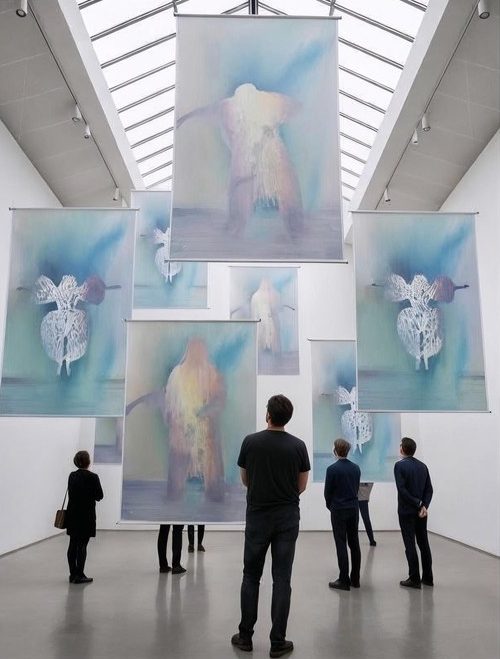
MACAAL, permanent exhibition "Seven Contours, One Collection," Marrakech, 2024 (© C.AYOUBELBARDII-MACAAL)

It was somewhat by chance that Franck Houndégla, a designer and doctor of architecture, turned to exhibition scenography, during an internship at the office of Philippe Délis, architect and scenographer. He especially appreciates this specialty for its relatively short development time compared to architecture, allowing him to quickly see the results of his work.

His six years at the agency gave him the opportunity to cut his teeth on major projects before co-founding the Bi.cks agency and, a few years later, embarking on his own projects in museum design and, more generally, in the planning of public and private spaces. The renovation of the historical museum exhibition in Abomey, Benin (1997), the curatorship and scenography of the exhibition “Singulier Plurielles. In Contemporary Africas” at the Saint-Étienne Design Biennale (2022), the Benin Pavilion at the 60th Venice Biennale (2024), and the scenography of the permanent exhibition at MACAAL: Museum of Contemporary African Art Al Maaden in Marrakech (2025) are just a few of his memorable achievements.

A prolific body of work nourished by his cosmopolitanism. Born in France to Beninese parents, Franck Houndégla has cultivated an international career, particularly on the African continent, which he has been keen to explore since his youth. This experience now enriches his scenographies with lessons learned on both sides of the Mediterranean.

Exhibition: An Open Book

As a teacher and author of several books, Houndégla clearly has a strong passion for sharing knowledge. In his discourse, the focus is less on walls and hangings than on narrative, meaning, and pedagogy. For Franck Houndégla, the exhibition is a means of sharing knowledge through objects and space. It offers a form of mediation between researchers and the general public, an alternative to books and often more powerful because it is more immediate.

Science is among his favorite subjects, with notable achievements for the Cité des Sciences et de l’Industrie in Paris, as well as cultural and heritage transmission, as seen in the Benin Pavilion in Venice. There, the curatorial team, composed of Azu Nwagbogu, Yassine Lassisi, and Franck Houndégla, invited four contemporary Beninese artists—Romuald Hazoumé, Chloé Quenum, Ishola Akpo, and Moufouli Bello—to interpret social issues such as the rise of African feminisms, vodoun, spirituality, or the slave trade—a remarkable opportunity to share Beninese heritage internationally.

The Love of Objects

As a designer, Franck Houndégla places the object at the heart of his scenographies, as an actor rather than a mere prop. His international experience has taught him how the status and movement of objects can differ from country to country. While in Europe, objects rarely leave museums, in other countries, they circulate much more freely, are loaned by communities, and even brought out for ceremonies. Thus, for “Togo des Rois,” presented at the Palais de Lomé in 2019, Franck Houndégla, in collaboration with Sophie Schenck, Péroline Gonçalves, and Arsène Younang, took on the challenge of designing an exhibition without a collection, gathering exclusively objects loaned by local chieftaincies. This experience informs his vision of the object as living, rather than as a museum piece.

In Houndégla’s stagings, the object is never neutral, but always charged with history—witness to an era and a society. He recalls with emotion the glass works created by artist Chloé Quenum for the Benin Pavilion, representing musical instruments: not reproducing the instruments, but transforming them into works of art to perpetuate them, to preserve their memory in the simplest way, without writing a book.

This vision of the object as an act of presence, beyond aesthetics, is also found in the “Singulier Plurielles” exhibition, where Houndégla, assisted by Cléa di Fabio and in collaboration with graphic designer Laura Quidal, chose to highlight design practices at different scales, not limited to domestic settings or designer pieces. A Moroccan hospital ventilator was displayed alongside a hand-washing station from Senegal and even a car from Madagascar. This experimental approach brought a diverse array of projects into the spotlight, showcasing the pragmatic and joyful innovation of the African continent.

Inhabiting Space

Objects come to life in the scenographic space. Houndégla approaches space less as a constraint than as a vast field of possibilities. The use of different media, sound, or even simply the movement of visitors, multiplies the ways of conveying meaning, far beyond what a book can offer.

He recalls the exhibition Africa. Religions of Ecstasy at the Musée des Confluences in Lyon, on which he had collaborated notably with set designer Sophie Schenck and graphic designer Brice Tourneux. Instead of traditional wall displays and hangings, the team preferred to inhabit the empty spaces with “large objects,” creating polarities around which visitors circulated. This staging, he explains, echoed certain forms of spatiality common in Africa, with an organic, evolving space whose form arises from practice. A range of sound and visual effects contributed to the immersive experience: ritual chants, low-frequency vibrations evoking possession drums, and animated silhouettes projected on the floor.

This mastery of space was also put to use in the “Liaisons Urbaines” program. Born from the observation that public spaces in African cities, poorly adapted to the practices of their inhabitants, remain underused, the project aimed to breathe new life into spaces ranging from 300 to 2,000 square meters. The experiment, conducted with local and international partners in several cities across the continent—including Porto-Novo, Gorée, Casablanca, and N’Djamena—involved designers from various disciplines: painters, sculptors, architects, designers, and visual artists, both beginners and established. The project was rewarding for young creators, happy to see their work recognized, as well as for residents, who were directly involved in the reflection around a concrete project that concerned them.

This experience is part of Franck Houndégla’s broader reflection on African urbanism, and more specifically on how residents produce their cities—a subject he explored in his thesis. By creating their own environment and relying on networks of construction artisans, residents naturally turn to the most practical and economical materials and methods: cement blocks and concrete, rather than more technical materials like raw, stabilized, or fired earth. While this approach meets short-term housing needs, it raises sustainability issues that Franck Houndégla urges to address quickly. Let’s hope his voice is heard and that his experience contributes to this urgent and essential reflection.

More articles on the subject

Share the article
also read
  • All Posts
  • Lifestyle
  • Beauté
  • Culture