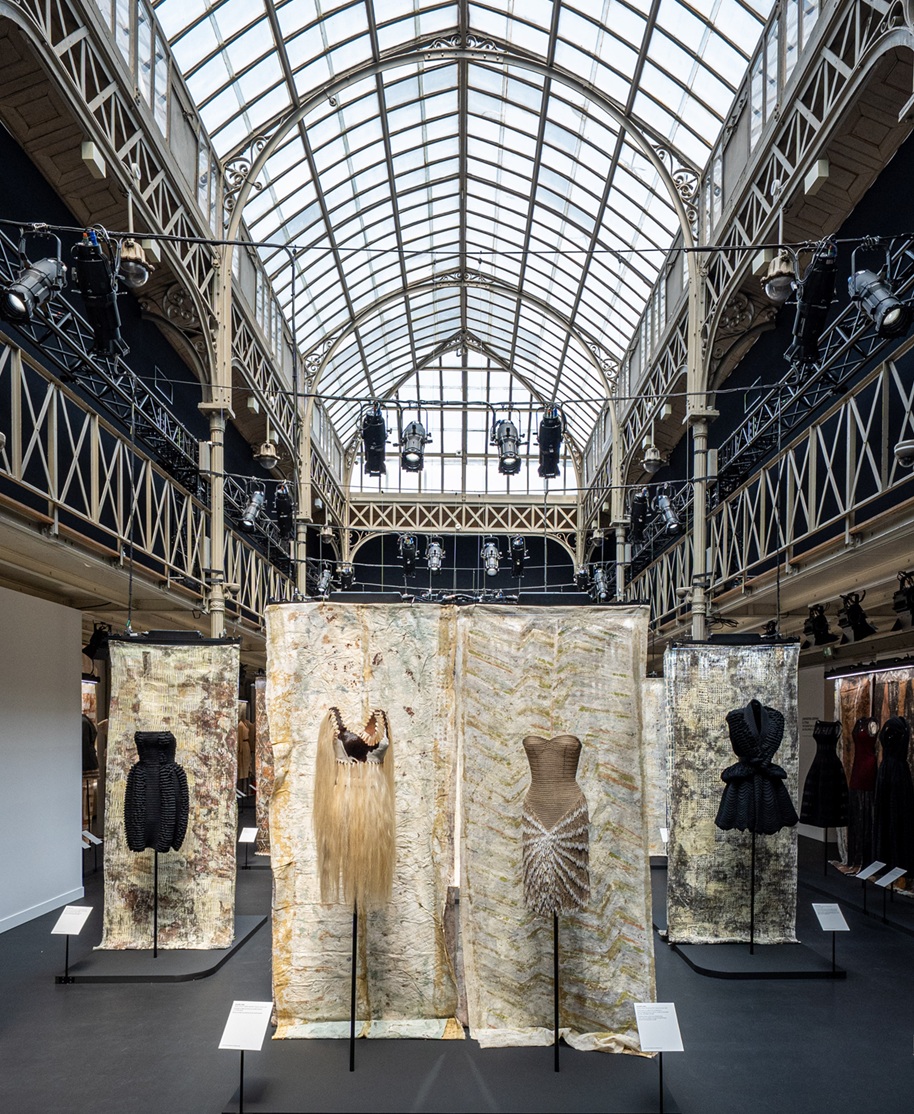
Under the curation of Ousmane Mbaye, a renowned Senegalese designer, an entire section dedicated to design took residence in the Former Palace of Justice in Dakar as part of the Dak’art Contemporary Art Biennale, held from May 15 to 30.
Supported by a rich and dynamic scenography, the exhibited works illustrated the diversity of techniques and the evolution of design in Africa, transcending traditional craftsmanship to address modern concepts such as ergonomics and functionality.
Intergenerational Dialogue
About thirty creators from across the continent – Burkina Faso, Côte d’Ivoire, Mali, Morocco, Nigeria, Senegal, South Africa – offered a rich and diverse panorama of the African design scene. The presented works demonstrated a resolutely contemporary approach to design while drawing from African artisanal traditions.
Established talents were represented, paying homage to the founding and emblematic creations of contemporary African design. Visitors were able to (re)discover some of the masterpieces by Jean Servais Somian, Hicham Lahlou, Fatimata Ly, Bibi Seck, and Cheick Diallo.
Alongside them, young emerging talents, exhibited for the very first time, were delighted with this excellent showcase for their work and the exceptional opportunity for meetings and exchanges.
Materials in All Their Forms
Reflection on materials occupied a central place in the exhibition, with thematic rooms dedicated to various materials, from their fabrication to their reinterpretation. This approach allowed for highlighting the incredible work of conception and appropriation by designers.
Many creators showcased local materials, reinventing them with boldness and creativity. Wood, raffia, leather, and traditional textiles were thus sublimated into furniture pieces and everyday objects with clean, contemporary lines.
Ecological commitment was also present in the work of many designers. Several projects explored the possibilities offered by upcycling and circular economy, transforming waste into design objects as beautiful as they are useful, such as spectacular lighting fixtures made from plastic bottle caps.
Not to mention new technologies, illustrated by the work of two Nigerian designers, Ifeanyi Oganwu and Charles O. Job, demonstrating the extraordinary finesse of cutting work made possible by the latest techniques.
Design in Reflection
Beyond the spotlight on African design talents, the Biennale was an opportunity to deepen reflection on the role and challenges of design through a series of meetings and exchanges.
Workshops and masterclasses led by renowned designers offered visitors the opportunity to learn various techniques and interact with creators.
A series of conferences and round tables addressed crucial themes for the future of design in Africa: sustainability, social innovation, preservation of traditional know-how, and the place of design in the African creative economy.
This reflection is expected to continue in the next edition of the biennale, scheduled for 2026, which already promises to consolidate the prominent place given to design.