A worn jute sack, an abandoned bottle, a seat that no one occupies anymore. These objects seem to belong to a bygone world. Yet they have much to tell us: about the people who made or transported them, the goods that circulated, the industries that sustained entire regions, and the political projects that sought to change the course of history.
It is in these everyday traces that Ibrahim Mahama finds much of his material. For several years, the Ghanaian artist has been collecting discarded materials, relocating them and assembling them to give them a new existence. But his work is not simply about turning used objects into artworks. Their histories remain visible, with all their marks, uses and ruptures. By weaving them into a different narrative, Ibrahim Mahama invites us to reconsider what the past has left behind.
At the Fondation Cartier, this approach takes on a collective dimension. Alongside his own installations, the artist has invited a selection of artists and collectives whose work resonates with his concerns, each drawing on their own histories, images and materials. Together, they explore the hopes born of the great political upheavals of the twentieth century, the visions of society that accompanied them, and what remains of them today. For interrupted projects do not simply disappear: they continue to generate questions, fuel imaginations and, at times, open up new possibilities.
A Collective Harvest
Born in 1987 in Tamale, in northern Ghana, Ibrahim Mahama has established himself over the past decade as one of the leading figures on the international art scene. Early on, he developed a practice of monumental installations made from collected materials — jute sacks, wood, furniture, archives and fragments of industrial architecture — through which he explores labour, trade flows and Ghana’s collective memory. His distinctive approach has earned him international recognition: in 2025, he became the first artist from the African continent to top ArtReview’s Power 100, which ranks the most influential figures in contemporary art.
This recognition celebrates both the singularity of his work and the collective dimension at its core. His installations involve local communities, from the collection of materials to their transformation. In Tamale, he has also established spaces where other artists can work, experiment and present their work. The Savannah Centre for Contemporary Art, Red Clay and Nkrumah Voli-ni host exhibitions, residencies, student projects, children’s workshops and research programmes, while contributing to the preservation and transmission of the heritage of northern Ghana.
It is in this spirit that The Harvest Season, Ibrahim Mahama’s first major exhibition in Paris, takes shape. Together with nine participating artists and collectives, he occupies all the spaces of the Fondation Cartier, on Place du Palais-Royal, transforming them into a territory for creation, experimentation and transmission. He envisions it as “a living entity in resonance with the art centres he has founded in Tamale”.
The title, The Harvest Season, evokes the “patient cycle of creation”: sowing ideas, passing on knowledge and reaping the fruits of collective commitment. This sense of long-term engagement and transmission runs throughout the exhibition, from materials weathered by use to the images and narratives brought back to life by the artists.
Ibrahim Mahama: Giving a Second Life to Traces of the Past
Ibrahim Mahama’s style is first recognisable through its scale: his works do not simply occupy a space; they transform it. Using jute sacks, discarded furniture, industrial waste and archival documents, he constructs monumental environments that bring the histories of labour, trade, migration and Ghana’s political projects into the museum.
His distinctive approach also lies in the way he handles materials. In his hands, a jute sack is far more than a surface: having been used to transport cocoa or coal, it bears the marks of the hands, markets and economic networks through which it has passed. By assembling, stitching or unfolding it on a monumental scale, Ibrahim Mahama does not simply “recycle” it. He gives it a second life as a sensitive archive, making material history visible. The object retains the traces of its past while opening itself up to another existence.
The exhibition offers an overview of this practice through monumental installations emblematic of his approach. The first can be discovered before entering the galleries: a textile installation occupies the arcades of the Fondation Cartier’s façade, visible from Place du Palais-Royal. This gesture has precedents, from Out of Bounds, presented at the 2015 Venice Biennale, where the artist covered part of the Arsenale with jute sacks, to Purple Hibiscus in 2024, which saw London’s Barbican clad in approximately 2,000 square metres of fabric handwoven and sewn by artisans from Tamale.
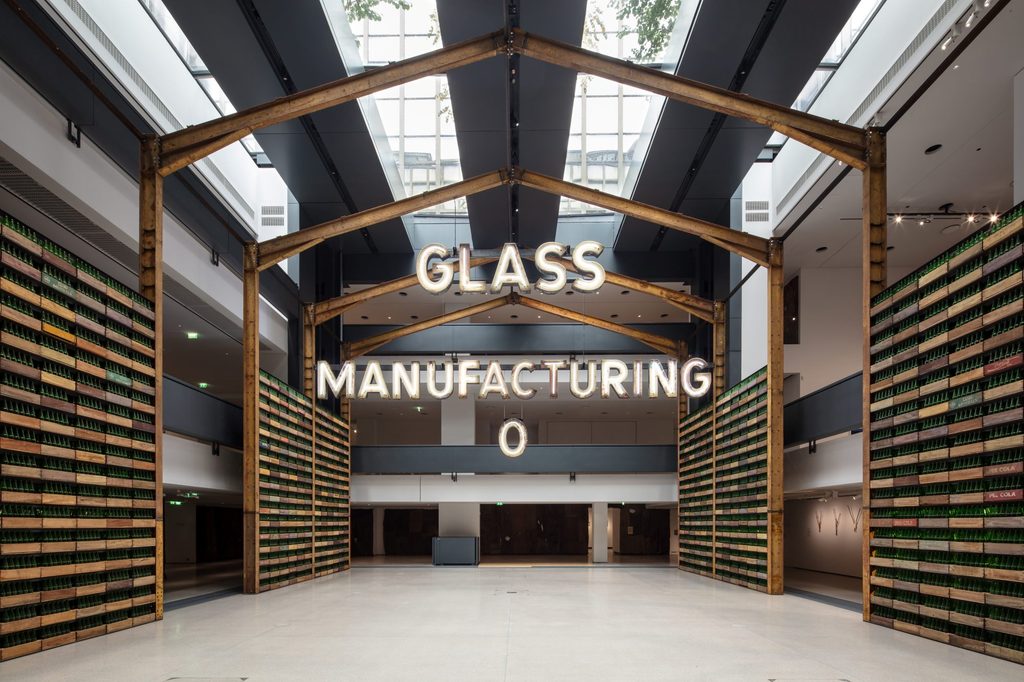
Inside, the exploration continues with Things Fall Apart. The work draws on the history of a glass-bottle factory inaugurated in 1966, amid the industrial ambitions of newly independent Ghana, before it was eventually abandoned. Acquired and dismantled by Ibrahim Mahama, the building found a second life in Tamale as part of an artistic and educational project. For the Fondation Cartier, the artist has created a site-specific installation using original materials from the factory: its sign and metal framework, along with more than 25,000 bottles arranged in a thousand crates, bring an entire chapter of Ghana’s industrial history back into view.
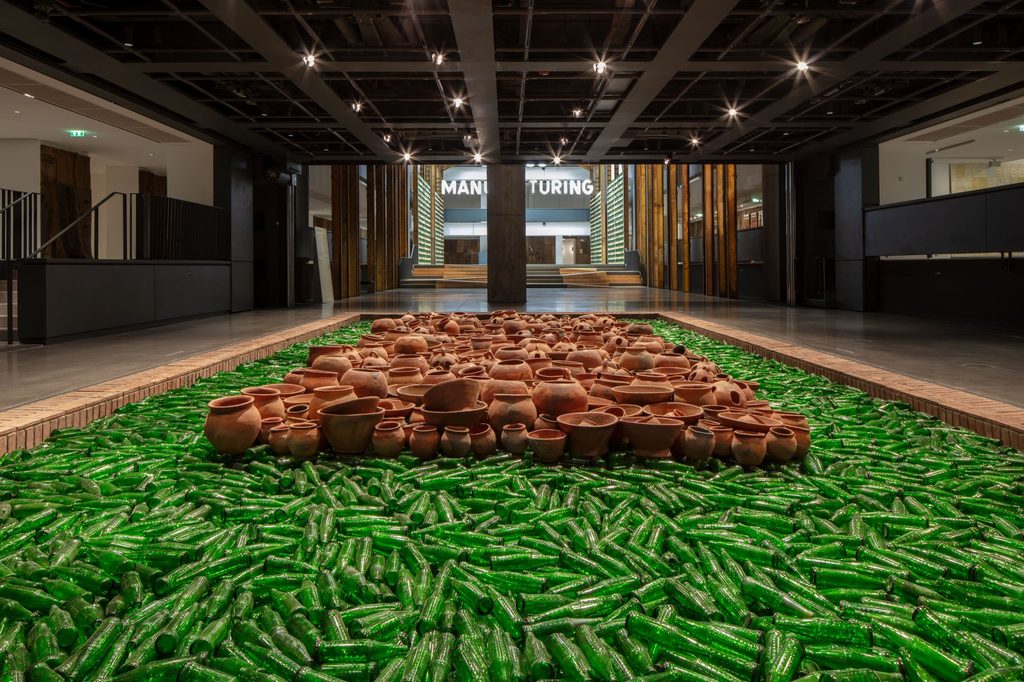
With Season of Migration to the North, Ibrahim Mahama extends this narrative by turning his attention to abandonment. Thousands of green bottles from the factory form a kind of lawn, punctuated by terracotta vessels. The installation echoes what the artist discovered on site: plants and animals had taken over the industrial ruins, turning them into a living environment. What can be harvested from a place that no longer produces? The work shifts the focus away from interrupted ambitions alone, towards the forms of life and possibilities for transformation that survive them.
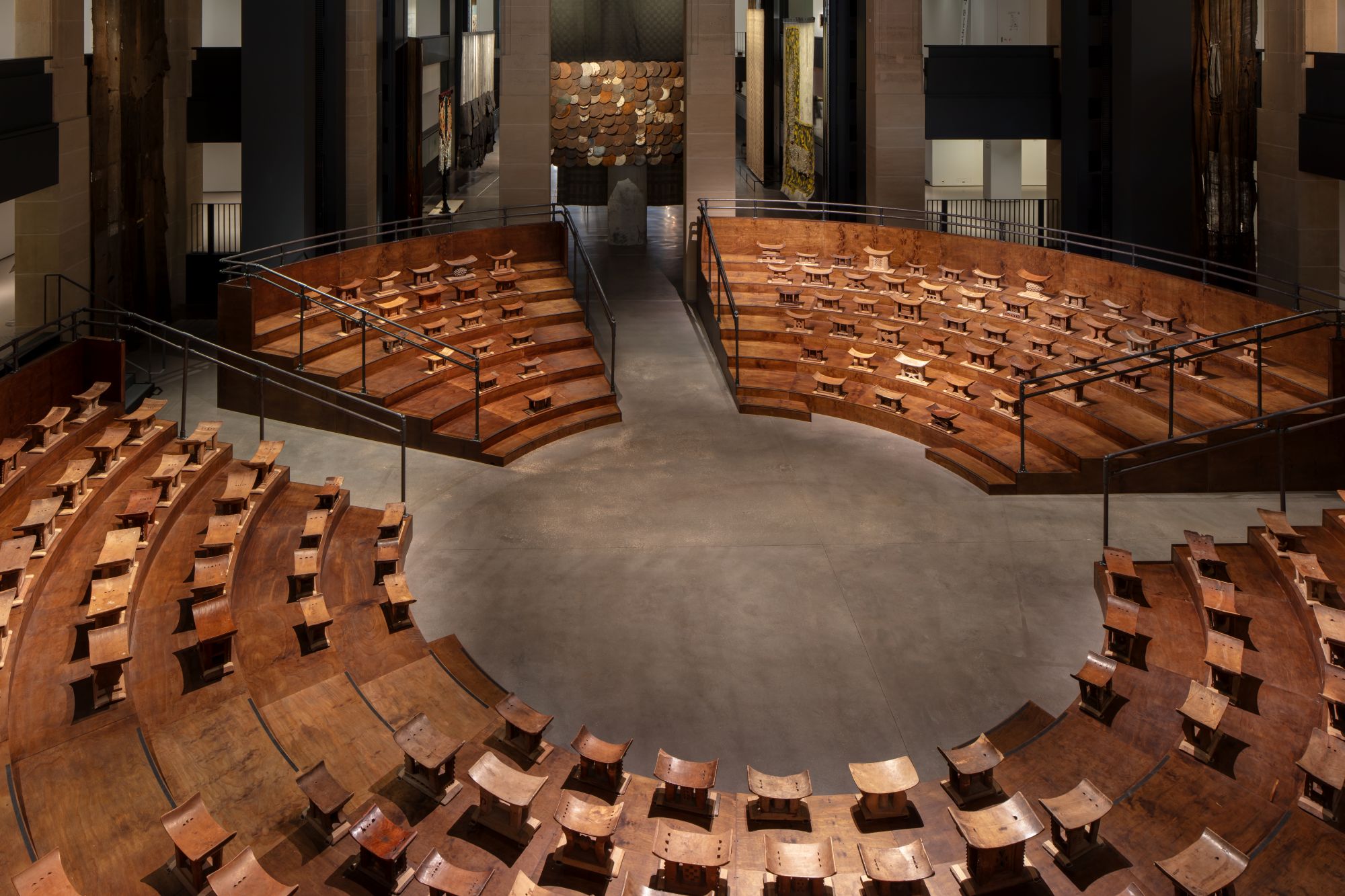
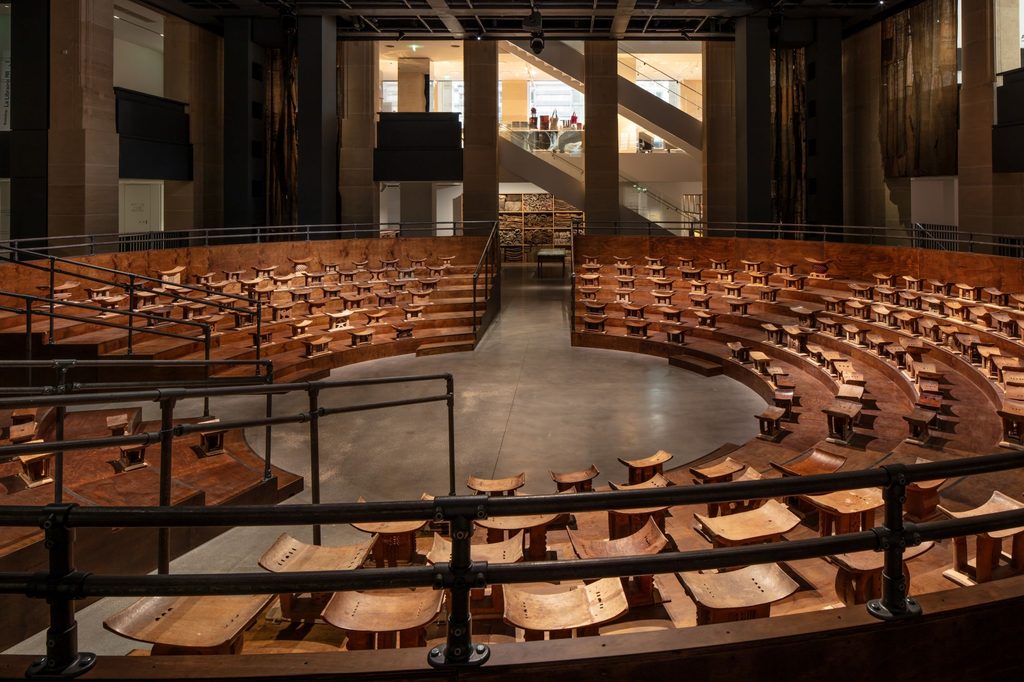
Further on, the historical reflection on the upheaval of 1966 continues with Parliament of Ghosts, which refers to the coup d’état and the dissolution of the government. Ibrahim Mahama brings together traditional Ashanti wooden stools in a configuration evoking a parliamentary assembly. First created in 2019 for the Whitworth in Manchester and subsequently adapted for other venues, the installation arrives in Paris in a renewed version. Visitors are invited to sit on the stools: the work becomes a living space designed to host gatherings, debates, concerts and performances.
Together, these works establish the grammar of Ibrahim Mahama’s practice: gathering materials and places charged with history, giving them a new form, and setting them back into circulation. They also prepare the ground for the encounter with the invited artists, who extend these questions through other archives, materials and narratives.
Artists in Dialogue: A Community of Perspectives
For The Harvest Season, Ibrahim Mahama has brought together artists and collectives with whom he has developed long-standing collaborations, research projects or exchanges. Among them are his fellow Ghanaians James Barnor, renowned for his photographic work documenting Ghana around independence; Dorothy Akpene Amenuke, Ibrahim Mahama’s former teacher, who shares his interest in textiles; Gideon Appah, who studied, like Mahama, in Kumasi and whose paintings draw on archival imagery; and Courage Dzidula Kpodo and Postbox Ghana, who explore architecture and representations of modernity.
The invited artists also extend the conversation beyond Ghana. Zohra Opoku, who is German-Ghanaian, works with textiles and personal photographs. Originally from the Democratic Republic of the Congo, the Cercle d’Art des Travailleurs de Plantation Congolaise (CATPC) brings together artists and plantation workers; proceeds from sales of their works help fund the repurchase of agricultural land confiscated during the colonial era. Slovenian artist Tjaša Rener explores the connections between Kwame Nkrumah’s Ghana and Tito’s Yugoslavia, particularly through migration and the exchanges that took place between non-aligned countries. Feda Wardak, a French-Afghan artist and architect, examines the effects of war, extractivism and imperial legacies on inhabited territories.
Behind this diversity lies a community united by shared work, gestures and concerns. The artists explore common themes of memory, colonial and postcolonial legacies, emancipatory projects and futures left in abeyance. The 1950s and 1960s saw political, social and cultural utopias take shape: some were realised, while others were interrupted or transformed. The exhibition asks what remains of these aspirations and what they might still help us imagine.
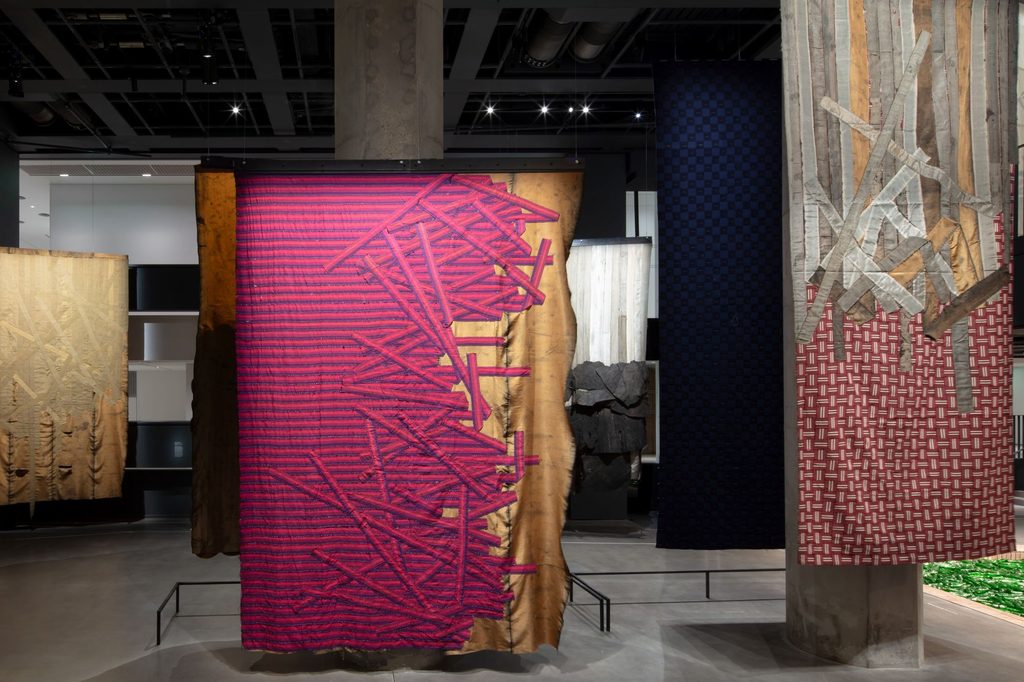
This shared reflection takes shape through different practices, brought together by their extensive use of materials that carry memory. The dialogue begins with textiles. Dorothy Akpene Amenuke shares with Ibrahim Mahama an attentiveness to materials and the gestures that transform them. In Pandamous Scroll, a seventeen-metre-long work, she combines pandanus matting, jute cloth and rope, dried banana bark and handmade paper. Zohra Opoku, for her part, prints personal photographs onto vintage fabrics, which she dyes, embroiders and assembles. CATPC creates cocoa sculptures and jute-cloth embroideries in collaboration with Ibrahim Mahama.
Photography, painting and printed archives extend this exploration. James Barnor offers a perspective on Ghana around independence, urban modernity and the diaspora. His period photographs and albums reveal the transformations of Ghanaian society and the connections between Africa and Europe. These archives are joined by large-format Polaroid portraits made with Ibrahim Mahama during their meeting in Tamale in 2024. Presented for the first time in this exhibition, the portraits bring two generations of artists and two approaches to constructing visual memory into dialogue.
Gideon Appah continues this dialogue by reworking advertisements, newspapers and popular imagery from Ghana dating from the 1950s to the 1980s. His paintings do not reproduce these archives in a documentary manner; instead, they shift them into a dreamlike realm, where memory takes on fictional hues and the past becomes pictorial material. His work is represented by around thirty pieces, marking the first presentation of this scale of his work in Europe. With Postbox Ghana, postcards and stamps bring the country’s architecture and urban landscapes back into view, particularly the modernist forms associated with this period.
Courage Dzidula Kpodo approaches this memory through the building itself. In Our Early Plans, he presents a partial reconstruction of a farmer’s house, assembled from architectural elements that have been displaced and reassembled within the exhibition. Vernacular heritage is no longer evoked solely through images or documents: it takes physical form in the space as a fragmentary architecture.
These works resonate with Ibrahim Mahama’s installations: all return to projects of emancipation, modernity or collective life whose promises have not all been fulfilled. Their juxtaposition reveals the gaps between the hopes of the past and the realities that followed, while leaving open the possibility of passing something on or imagining it anew.
“From the past, we can unearth the potential of the future,” writes Ibrahim Mahama. At the Fondation Cartier, these futures remain to be questioned, passed on — and perhaps reclaimed.