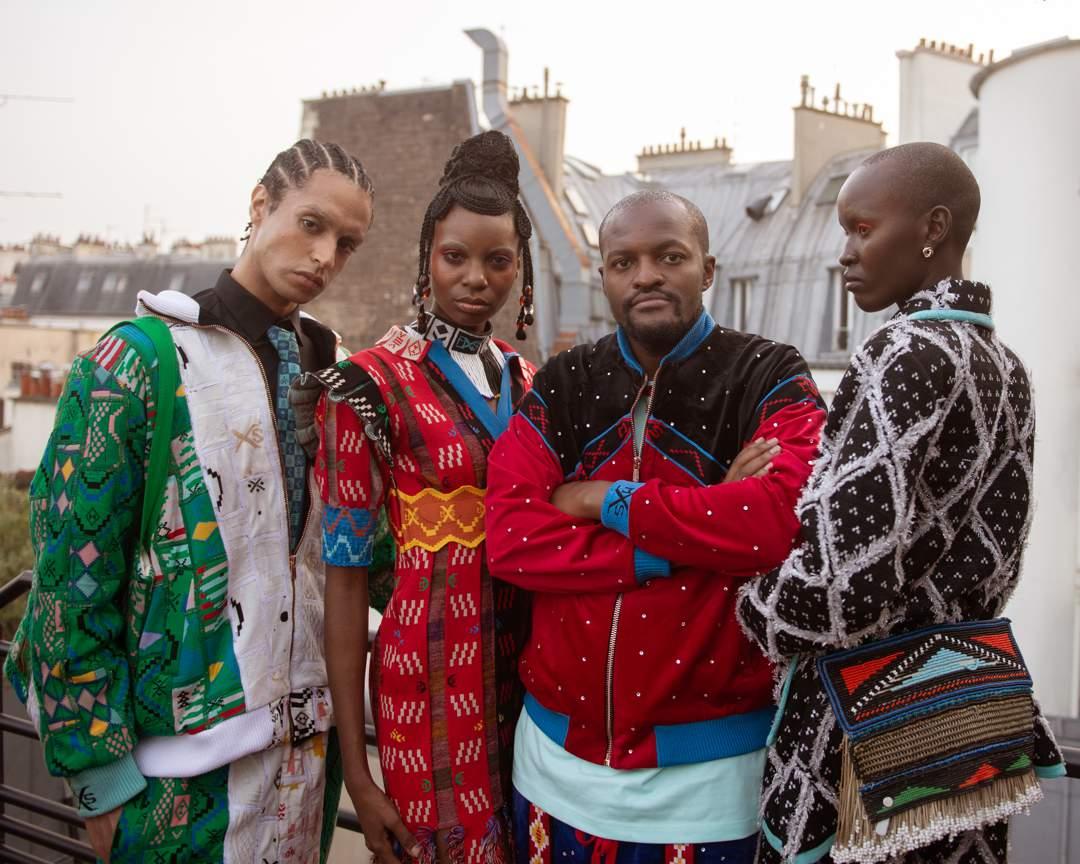
Over fifteen years, Laduma Ngxokolo has transformed an idea born in the Eastern Cape into a signature that now reaches far beyond South Africa. Maxhosa Africa draws on the motifs, colours and craftsmanship of Xhosa culture, translating them into a contemporary language that has gradually established itself on the international scene.
The house has continued to evolve this visual language, from a knitwear-based wardrobe rooted in Xhosa references to other African cultures, new silhouettes and new creative territories. It is this ability to bring tradition and contemporary design into dialogue that has allowed Maxhosa to establish itself internationally, with Paris now providing a new platform.
When Heritage Becomes a Language
Maxhosa’s distinctiveness lies first and foremost in the way Laduma Ngxokolo approaches his cultural heritage: not as a repertoire to be reproduced, but as a living source that can be translated and reinterpreted. Born in the Eastern Cape and a member of the Xhosa community, the designer draws on this cultural environment for the first elements of the house’s visual language.
The original idea emerged from the amakrwala, young men undergoing their initiation rite in Xhosa culture. This transition traditionally involves a specific wardrobe, including knitted garments and beadwork ornaments whose colours, geometric patterns and symbols follow a highly codified visual language. While studying textiles at Nelson Mandela University, Ngxokolo explored how to offer young men at this traditional stage of Xhosa life a contemporary wardrobe designed for a new generation. Rather than reproducing the ritual garments, he sought to reinterpret their essential elements in a new form. This reflection led to the creation of the brand in 2010, which would later become Maxhosa Africa.
The graphic codes of beadwork became one of the first pillars of this new language. Geometric patterns, contrasting colours, repetition and symbolic motifs were translated into the brand’s designs. They gradually became among Maxhosa’s most recognisable signatures, while moving away from any literal reproduction of traditional patterns.
Knitwear became the other pillar of this contemporary reinterpretation. Ngxokolo developed his technical expertise while studying textiles and grew up in this environment: his mother was herself a knitwear designer. He further developed this craft within a South African context rich in local textile expertise, while working with locally sourced materials, notably wool and mohair. At Maxhosa, jacquard, intarsia, embroidery and various forms of handwork allow the motifs to become part of the construction of the garment itself. Knitwear is therefore more than a medium: it becomes a way of transforming the codes of beadwork into contemporary volumes, textures and silhouettes.
It is through this encounter between material, craftsmanship and graphic language that Maxhosa’s identity takes shape. The ritual garment is no longer reproduced; its two fundamental elements are reinterpreted and become the foundations of a new visual language.
Expanding The Territory Without Losing The Thread
As Maxhosa’s signature becomes established, its references broaden. Xhosa culture remains an essential component of the house’s vocabulary, but Laduma Ngxokolo also draws on other African cultures, histories and imaginaries. Alkebulan, the Autumn-Winter 2022 collection, opened the field to a more pan-African vision, bringing together the codes developed around Xhosa culture with references from other parts of the continent. It was during this evolution that MaXhosa by Laduma became Maxhosa Africa. The name change reflected the brand’s expanding territory: Xhosa culture remained its foundation, while the house embraced a broader African identity.
The wardrobe evolved as well. After building its reputation around menswear knitwear, Maxhosa launched Buyel’mbo, its first womenswear collection, in 2014. New silhouettes appeared — dresses, skirts, trousers, jackets and coordinated sets — while knitwear remained one of the house’s primary vehicles of expression. This evolution allowed Maxhosa to explore a broader range of constructions, including tailoring.
The language then gradually moved beyond clothing. Accessories and objects became new surfaces for the house’s motifs and colours. The collaboration with IKEA on the ÖVERALLT collection is one of the most visible examples of this expansion into design. Other projects followed, including a collaboration with Tile Africa on the Ntyatyambo tile collection. Motifs could move from knitwear onto rugs, cushions, objects and tiles. The move from fashion into lifestyle is less about reproducing the collections than about allowing Maxhosa’s codes to circulate across new media.
It is with this expanded vocabulary that Maxhosa now engages with an international creative scene, while continuing to build on its Xhosa origins.
A New Scale
Discovered in 2015 through Vogue Talents’ Scouting for Africa programme, Maxhosa presented its designs in Milan that same year. Over the following decade, the house expanded its presence across several markets, from Milan Fashion Week to Japan and then the United States. Its creations began to circulate among an international clientele and were worn by figures including Beyoncé, Michelle Obama and Alicia Keys. In 2024, Maxhosa opened its first New York store.
That same year, the house made its debut at Paris Fashion Week with My Conviction. Further presentations followed. It was not until September 2026, however, that Maxhosa reached another milestone: the house was officially included in the Paris Fashion Week schedule as a Show House.
On September 28, Maxhosa presented Izihlwele Zivumile, its Spring-Summer 2027 collection. For this first official Paris runway, Laduma Ngxokolo returned to his family’s Mpondo roots and to the landscapes of the Eastern Cape. The title — “The Ancestors Have Co-Signed” — places the collection squarely within the dialogue between heritage and contemporary creation.
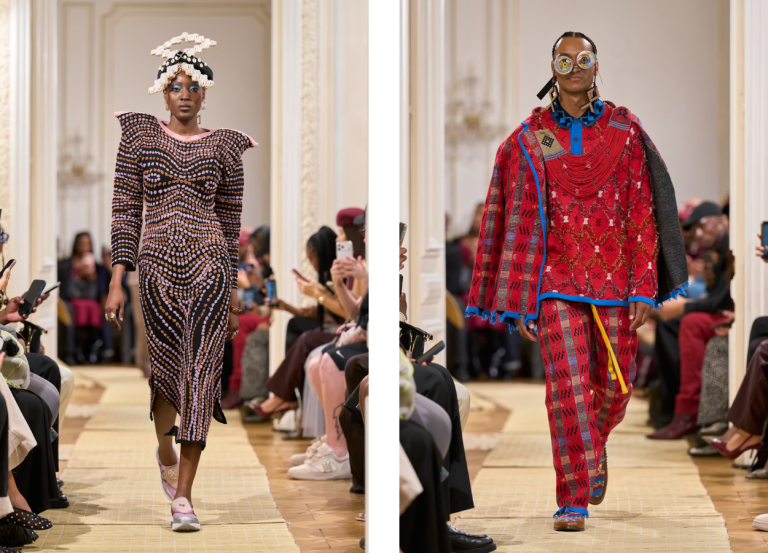
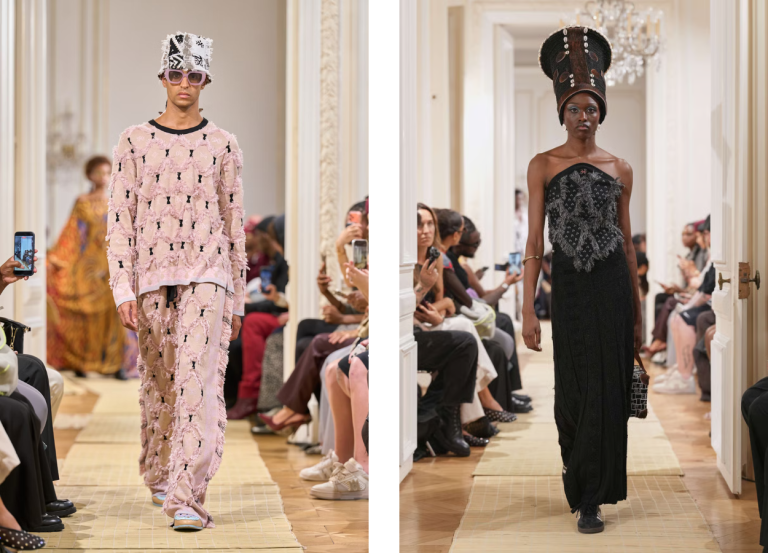
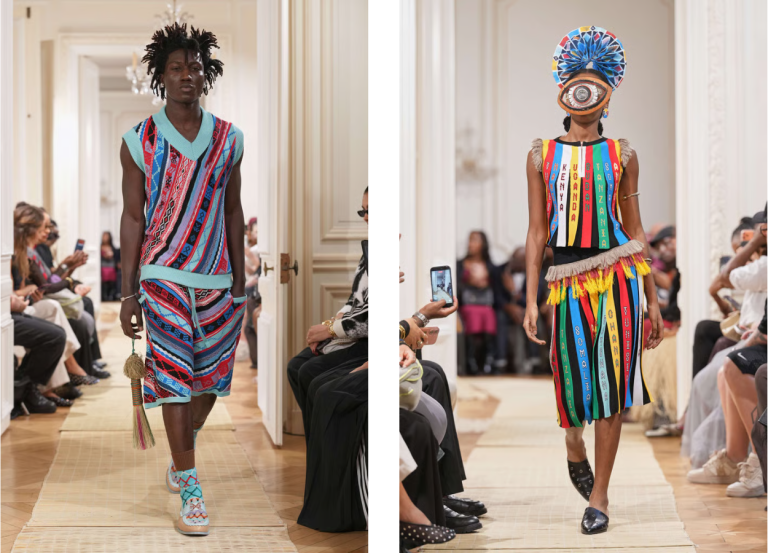
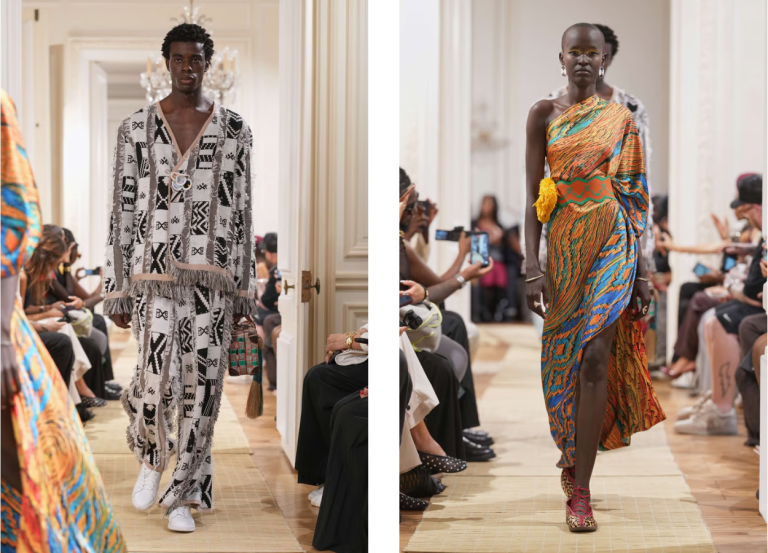
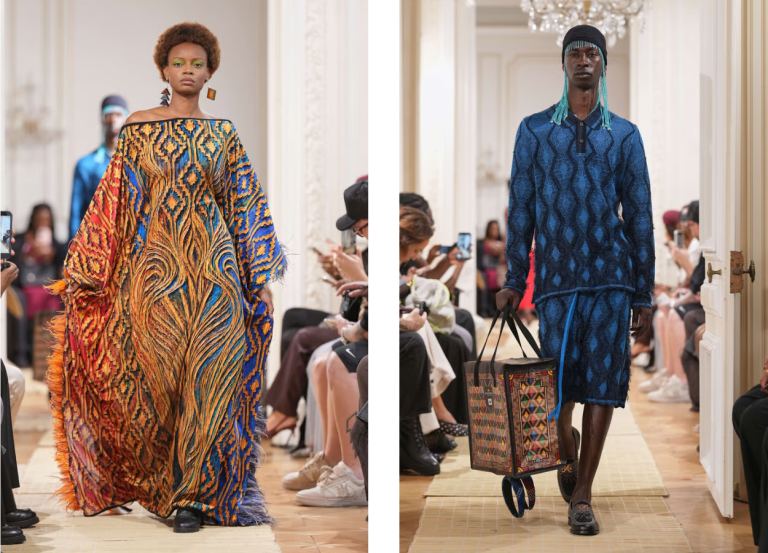
The collection provides a particularly clear synthesis of Maxhosa’s journey: it draws on the house’s foundations while showing how far its language has expanded. Motifs inspired by Xhosa beadwork remain present, while Mpondo references and broader pan-African influences play an important role. Some silhouettes feature the names of African countries as knitted labels, while another, in black and grey, depicts a large map of the continent.
The wardrobe reflects the same evolution. Knitwear remains central, but it now sits alongside a more diverse range of silhouettes, including dresses, pleated skirts, coordinated sets and tailoring. Among the most striking pieces were a multicoloured dress made of knitted tassels, each bearing the name of an African country; a highly graphic caftan trimmed with ostrich feathers; and several pleated knitwear silhouettes. The music of Sjava and eyewear by Kenyan artist Cyrus Kabiru, made from reclaimed materials, further extended the collection’s dialogue with other forms of African creativity.
Maxhosa’s inclusion in the official Paris Fashion Week schedule marks the culmination of an international journey that began more than a decade ago, from Milan to New York and now Paris. But it also comes at a moment when the house is looking to move onto another scale. Having established its language and international visibility, Laduma Ngxokolo is now looking towards new markets, with the ambition of extending that language from Canada to Brazil.
Another step, then, for a house intent on allowing a creation born in the Eastern Cape to travel further, without losing what lies at the heart of its identity.