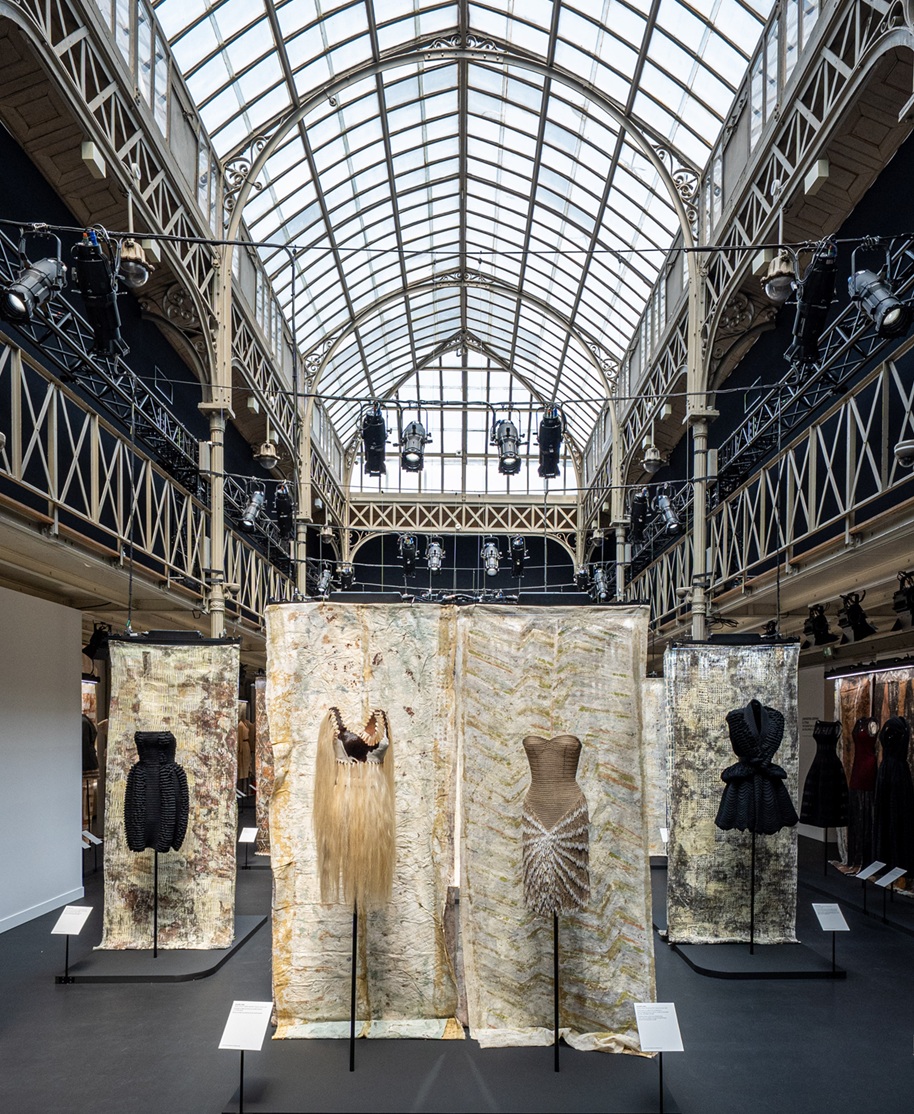
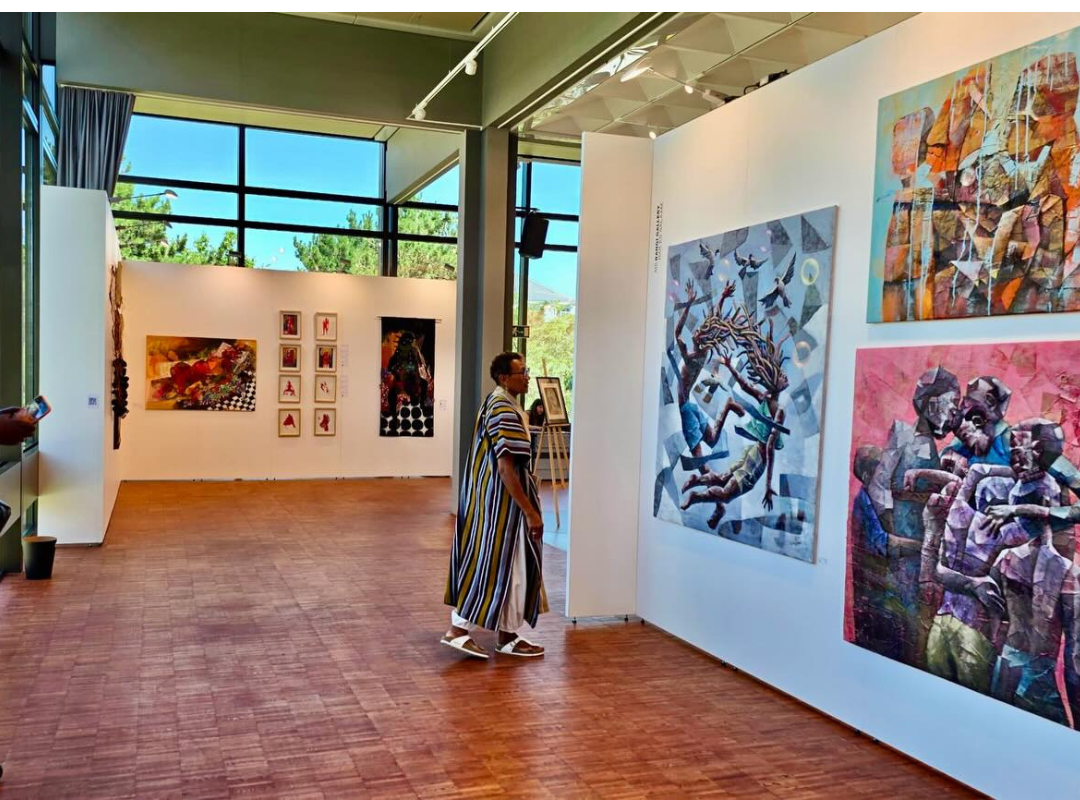
Beneath the glass roof of the Carreau du Temple in Paris, Serge Mouangue’s installation for this 10th edition of AKAA was undeniably one of the highlights of the fair. Between female silhouettes draped in Ndop fabric, hybrid masks, and floating textiles, his “third aesthetic” offered a captivating sensory and spiritual journey at the crossroads of Japan and West Africa.
Wafrica : A Space for Dialogue
For more than fifteen years, Serge Mouangue has been constructing a singular body of work at the intersection of design, art, and philosophy. Born in Yaoundé and trained in France, he began a career as an industrial designer that took him abroad, ultimately leading him to Tokyo. There, he discovered an unexpected proximity between Japanese and West African aesthetics—both nourished by a shared animist worldview.
This revelation gave birth in 2008 to Wafrica, a contraction of the Japanese word Wa—meaning both Japan and harmony—and Africa. With Wafrica, Mouangue initiated an unprecedented artistic approach: combining Japanese and West African aesthetic icons in a quest for equilibrium. “It’s not a fusion; it’s a marriage and a juxtaposition,” he explains. “I want to create spaces where cultures dialogue with each other.” He calls this concept “the third aesthetic”—a poetic and mental space where beauty arises from the tension between two symbolic systems.
This approach, both aesthetic and spiritual, runs through all his work—garments, sculptures, installations, and performances alike. Among his most iconic creations are first his wax-fabric kimonos, made in collaboration with Japanese master artisans, as well as his lacquered masks and sculptures, which merge West African statuary with the ancestral Japanese lacquer technique, as seen in his celebrated Blood Brothers series.


Material and Spirituality at the Hearth of AKAA
Epitomizing this “third aesthetic,” the installation presented at AKAA 2025 brought together several recent works within an immersive scenography.
From the entrance, Seven Sisters immediately caught the eye: a silent procession of fourteen life-sized female figures floating at eye level, as if about to come to life. Their faces, represented by Punu masks from Gabon, were adorned with kanzashi—Japanese hair ornaments—while their bodies were wrapped in Ndop fabrics from the Bamileke region in Cameroon. The work paid tribute to women and their hidden burdens, joy, and sorrow, its enigmatic title referring to fourteen figures but only seven sisters, united by a secret unknown to the other seven.
Above, Les Lucioles (The Fireflies) unfurled beneath the Carreau du Temple’s glass ceiling. Suspended in midair, the installation combined feathered juju hats, emblematic of Bamileke culture, with structures in indigo textile from Tokushima, adorned with Japanese motifs—cranes, bamboo, sakura leaves, turtles, and Mount Fuji. Symbolizing time and spirituality, the work embodied lightness and freedom, a sense of the ethereal.
Further on, TransAppearance presented a series of red resin sculptures inspired by Igbo fertility masks from Nigeria, arranged on a surface evoking a body of water. For the observant viewer, the back of each sculpture revealed a hollow impression of the face of an Omote Japanese Noh mask—here a symbolic representation of a birth spirit. Beyond its poetic resonance, the work also stands as a technical feat: it took the artist seven years to perfect its fabrication process.
Finally, the installation concluded with a sacred sculptural space titled Mamori-gami, meaning “guardian spirits.” It featured five worn Japanese kendo masks laid upon sacred shimenawa ropes. The masks were adorned with Cameroonian beads and traditional Bamileke patterns, embodying the duality of body and spirit, defense and contemplation. “Here, the mask is not an object of fear, but of protection,” the artist explained. “It reminds us that identity can be both armor and openness.”


Recognition of a Global Artistry
While Serge Mouangue’s work was a discovery for some Parisian visitors, it already enjoys international recognition.
The artist first gained prominence in Japan, and his nomination in 2011 as a TED Fellow—a program by the TED Foundation supporting high-impact creators—helped propel his work onto the global stage. Since then, his creations have traveled between Kyoto, Douala, and Paris, and have been exhibited in major institutions such as the Museum of Art and Design in New York, the Musée du Quai Branly – Jacques Chirac in Paris, the Charles H. Wright Museum of African American History in Detroit, the Marubeni Gallery in Tokyo, the V&A in London, and the Swedish National Museums of World Culture in Gothenburg, where several of his pieces have entered the permanent collections.
This success owes as much to Mouangue’s aesthetic and technical virtuosity as to the cosmopolitan vision that drives him. He embodies the figure of a global African artist—one unafraid to cross cultural borders and challenge conventions to create a new and personal visual language. “Wafrica is a way of signing, or expressing, over the long term—and hopefully for generations to come—a hope to find commonality through creation and art.”
More articles on the subject: