For Azzedine Alaïa, Africa is not a motif added to a collection. It is a way of looking at the world.
Born in Tunis in 1935 and trained in Paris, where he developed his singular creative language, Azzedine Alaïa never turned his origins into a manifesto. The exhibition deliberately begins with this silence, revealing how Africa permeates his work through a sensitivity to light, materials and movement rather than through overt references.


Africa’s Light
Before becoming a material or a form, Alaïa’s Africa is first and foremost a light.
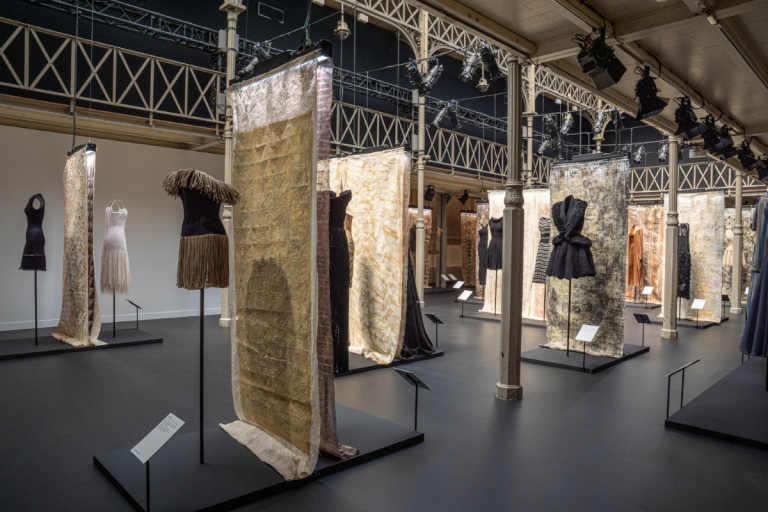
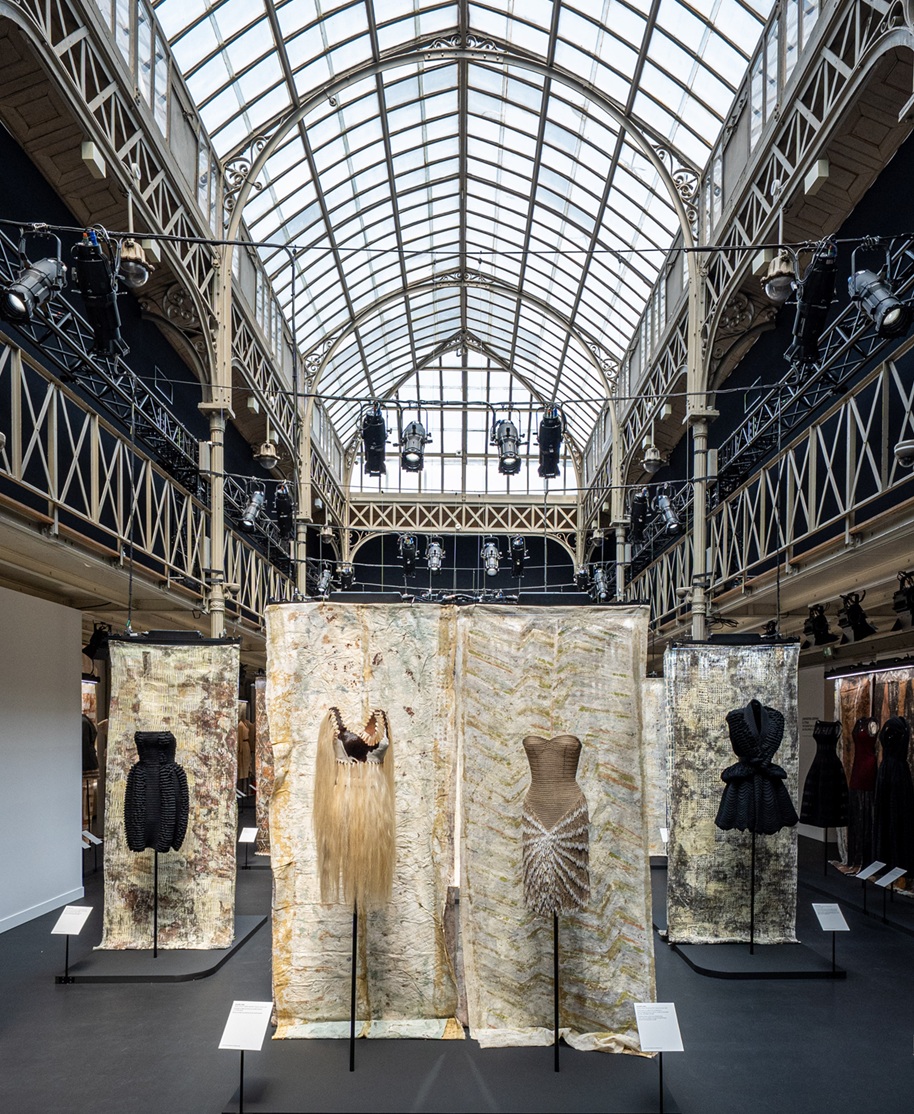
The exhibition opens against expectations. There is no explosion of instantly recognisable patterns, no spectacular display of colour. Instead, the opening galleries establish a dialogue between light and shadow, revealing an Africa of contrasts, mineral surfaces and deep tonalities.
This sensibility is rooted in the designer’s childhood. In the traditional houses of Tunis, light is rarely direct. It is filtered through mashrabiyas—the carved wooden screens that create intricate architectures of light. This memory of light runs through Alaïa’s entire body of work.
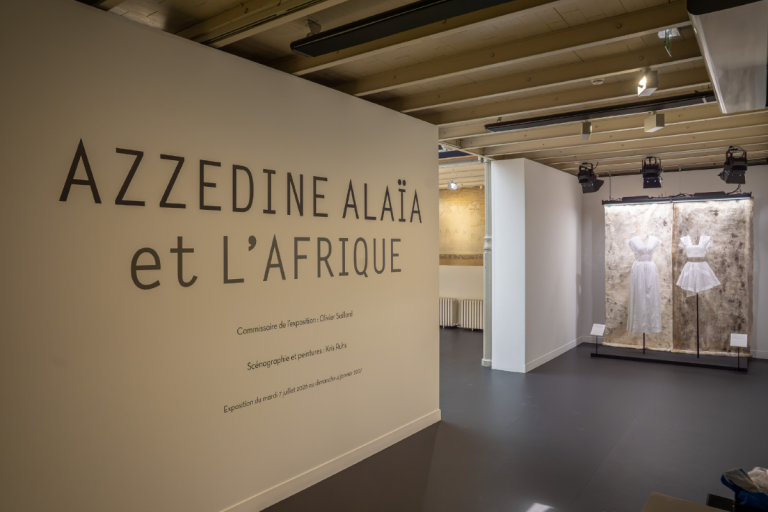
It first emerges in the white silhouettes displayed throughout the exhibition. Inspired by the lime-washed walls of his native Tunisia, the openwork cotton shirts and skirts echo the very principle of the mashrabiya: allowing light and the gaze to circulate while never revealing everything. White is never a neutral colour; it reflects light and amplifies its intensity.
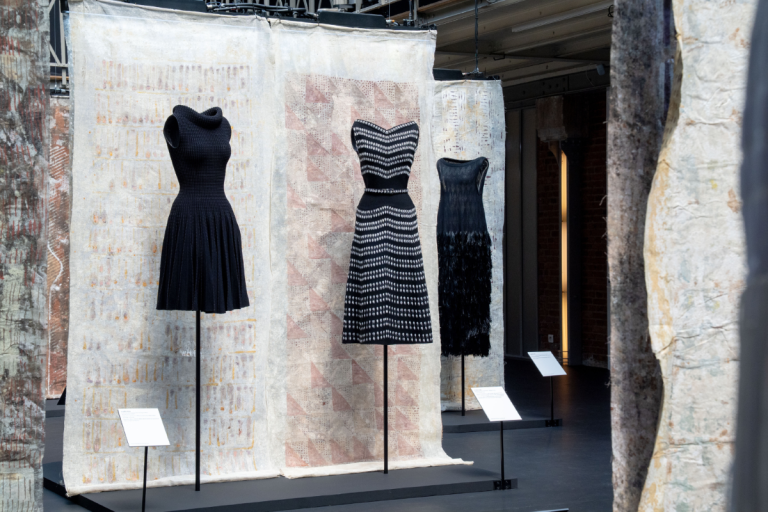
These luminous whites are answered by the collections of 1983 and 1984. Here, Alaïa explores every nuance of black. Where white reflects light, black absorbs it, revealing the precision of the cut and the sculptural quality of the volumes. Dense, protective and at times almost architectural, it becomes a material in its own right. Whether in body-conscious dresses or enveloping silhouettes, every curve acquires greater clarity.
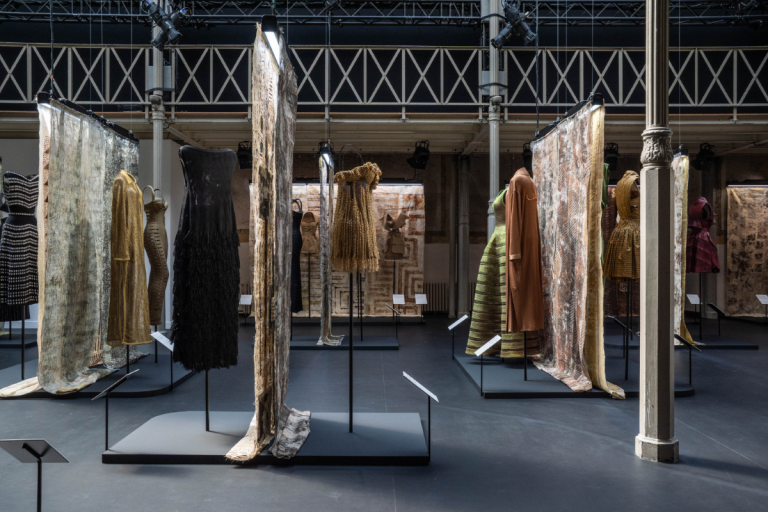
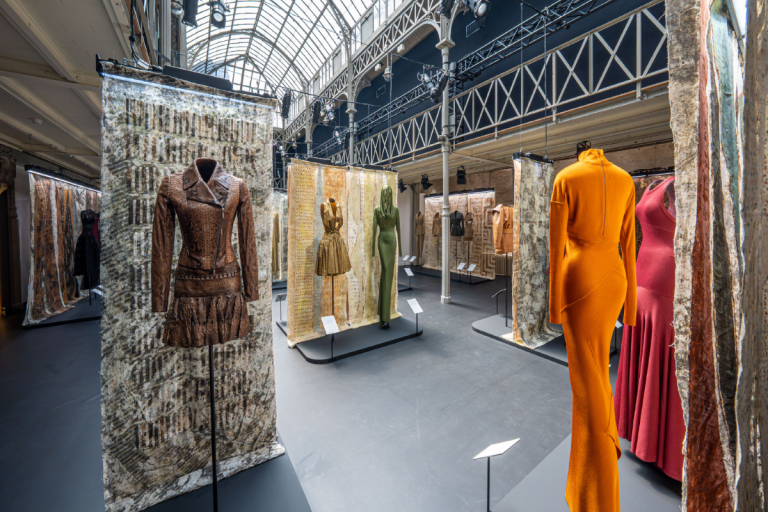
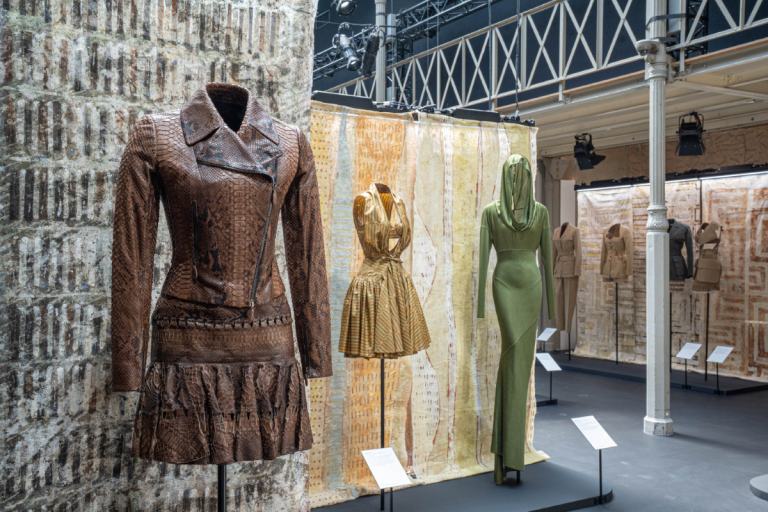
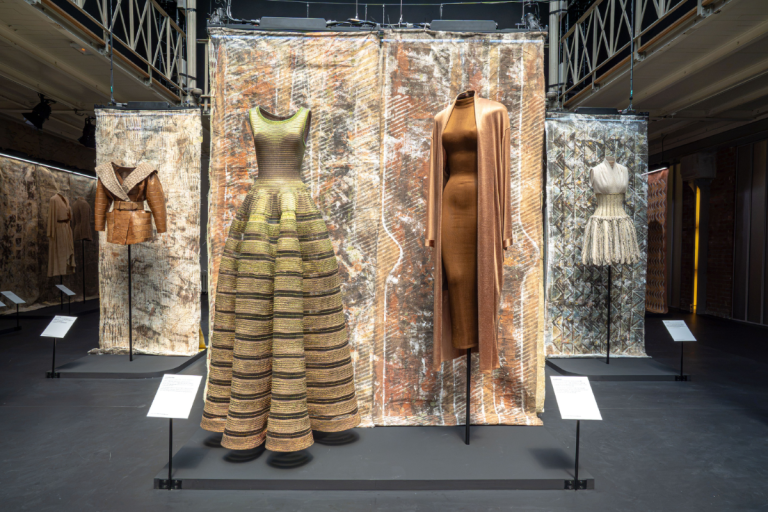
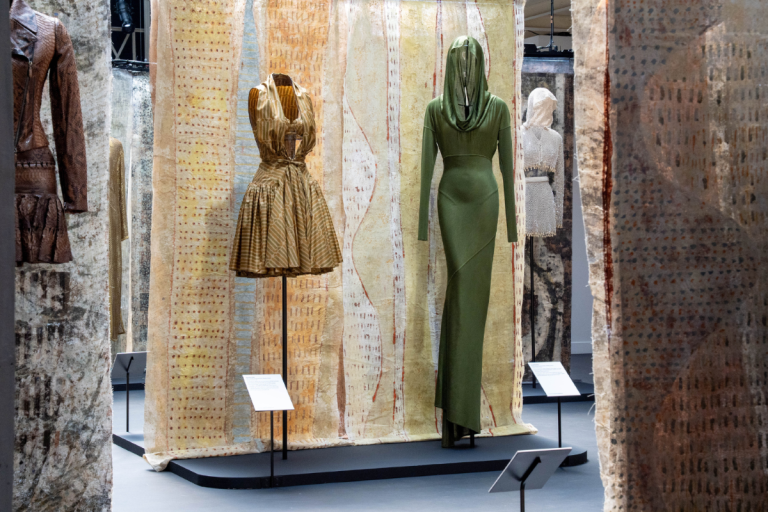
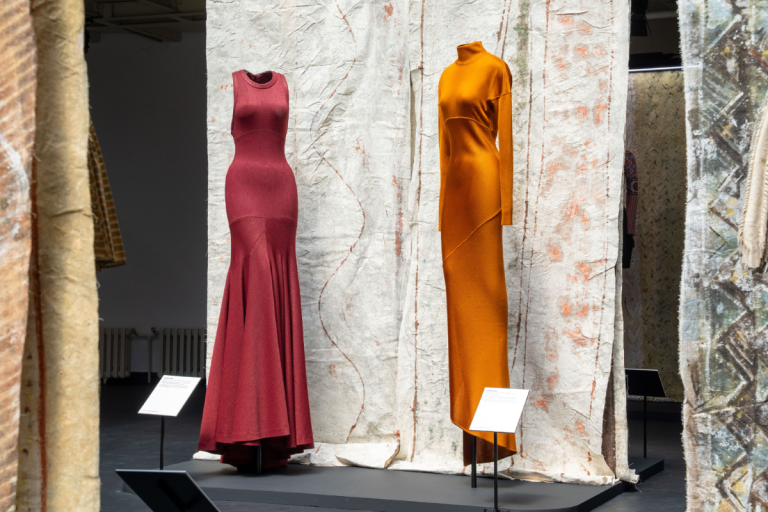
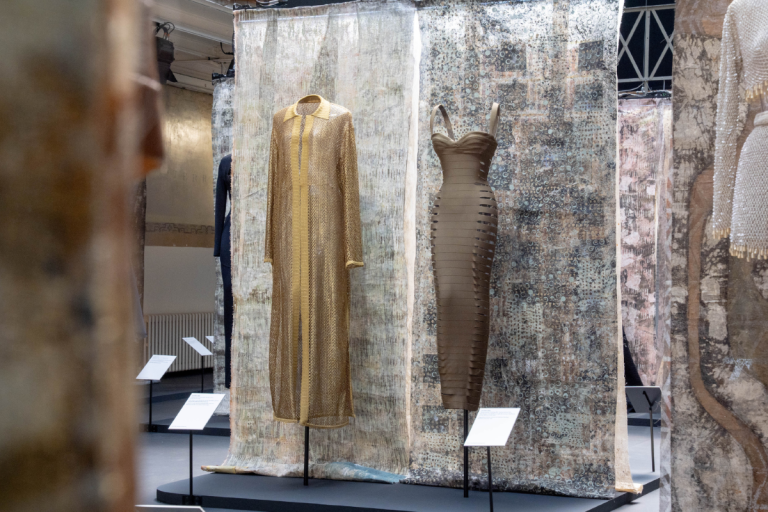
The exhibition then unfolds into a more earthy palette: sand, twine, putty, olive, brick, orange and bronze. These colours evoke less a landscape than a sensory experience of dust, stone and sun-warmed earth. After the white that reflects light and the black that holds it, they seem to preserve its warmth.
For Alaïa, colour never describes a place. It evokes a sensation.
Light soon finds its extension in materials. It is here that the dialogue between Alaïa and Africa becomes most tangible.
A Memory Stitched into the Body
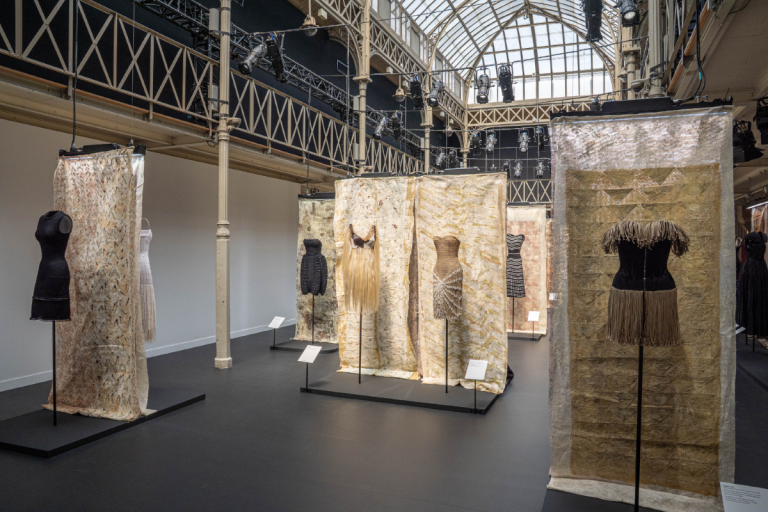
The exhibition’s curator, Olivier Saillard, devotes the heart of the exhibition to the Spring–Summer 1988, 1989 and 1990 collections. Here, Alaïa explores raffia, twine, macramé and cowrie shells not as markers of identity but as genuine creative materials.
Among the pieces on display, a 1987 jacket entirely covered in cowrie shells immediately captures the eye. Used for centuries across many parts of Africa as currency, adornment and symbols of protection, these shells carry a memory that extends far beyond their decorative function. In Alaïa’s hands, they are not simply applied to the surface of the garment: their repetition transforms its texture and relief. Ornament becomes an integral part of the garment’s very structure.
Cowrie shells reappear throughout the Spring–Summer 1988, 1989 and 1990 collections. Far from adding an exotic flourish, they fully participate in the construction of each garment, emphasising its lines, volumes and rhythm.
The same dialogue unfolds through raffia, twine and macramé structures. These natural fibres retain their irregularity, flexibility and distinctive way of catching the light. Alaïa never seeks to tame them; instead, he channels them through the precision of his tailoring, integrating them into silhouettes of remarkable refinement. The material retains its vitality while the garment gives it form.
The bandage dresses, first introduced in 1985, open another perspective. Inspired by Ancient Egypt, they wrap the body in successive bands of fabric. What might appear restrictive produces the opposite effect: each strip follows the body’s movement, emphasising the silhouette and revealing its mobility rather than constraining it.
Through these materials, the exhibition gradually broadens its perspective. The Africa that nourishes Alaïa is neither confined to a territory nor reduced to a vocabulary of forms. It belongs to a long history where craftsmanship, adornment, artisanal techniques and ancient traditions engage in dialogue. Materials become the place where memory and contemporary creation meet.
The Rhythm of Silhouettes
After light and materials, the exhibition turns to what truly animates Alaïa’s creations: movement.
More than an aesthetic effect, movement becomes a way of inhabiting both body and space. The silhouettes advance with quiet assurance, volumes accompany each gesture without ever restricting it, and every creation achieves its balance through a sense of fluidity.
On the upper floor, Peter Beard‘s photographs, taken during Azzedine Alaïa’s 1996 journey to Samburu country in Kenya, extend this reading. These visual archives remind us that it was in Kenya that Alaïa recognised what Olivier Saillard calls an “art of movement”: a slow, solemn gait, a singular way of carrying the body and inhabiting space. The photographs reveal the resonance between this discovery and a quest already present throughout his work: creating garments designed to accompany the body rather than constrain it.
The exhibition concludes with film footage from Alaïa’s fashion shows, offering a final demonstration of this idea. In motion, the volumes unfold, materials catch the light differently, and the precision of the cut becomes strikingly evident. What the motionless mannequins only suggested now becomes fully perceptible: for Alaïa, a garment is never a static sculpture, but a form conceived to move with the body.
By the end of the exhibition, it becomes clear that Alaïa’s Africa is neither a theme nor a source of inspiration in the conventional sense. It is a silent memory that permeates his way of working with light, materials and movement.
Rather than attempting to demonstrate an influence, the Fondation Azzedine Alaïa reveals this quiet continuity. It invites us to look anew at creations we thought we knew, discovering within them—almost imperceptibly—the imprint of an inner continent.