Inaugurated in 2000, the Pavillon des Sessions had introduced the arts of Africa, Oceania, and the Americas to the Louvre, which until then had focused primarily on European art. While this pioneering initiative marked its time by opening a debate on the place of non-European arts within the narrative of art history, it nevertheless remained limited: the works were confined to an ancillary space, on the margins of the museum’s main collections.
Twenty-five years later, the opening of the Gallery of the Five Continents on December 3, 2025, transforms this ambition. The collections now occupy a central position at the heart of the museum, where each civilization engages on equal terms with the others.
Bringing Cultures into Dialogue
While the Pavillon des Sessions focused on three continents, the new gallery adopts a global approach, open to all civilizations. Around 130 works—sculptures, ritual objects, architectural elements—are presented, drawn from the musée du quai Branly–Jacques Chirac, the Louvre, the Guimet Museum, the National Maritime Museum, and regional museums. An exceptional loan from Nigeria further enriches the ensemble. This broad selection allows cultures from all five continents to enter into dialogue.
Replacing a traditional geographical presentation—clear but compartmentalized—the Gallery of the Five Continents opts for a thematic organization. Birth and life, power and kingship, spirituality and belief, relationships with the environment: around these themes, sometimes unexpected encounters reveal correspondences that would escape a strictly regional reading. A Dogon maternity figure and a Spanish Virgin and Child offer a striking parallel around filiation and transmission. Elsewhere, a Roman statue of Aelius Caesar converses with a turu kuru grade sculpture from Vanuatu, each embodying power and authority in its own way. An Egyptian canopic jar and a moai head from Easter Island evoke relationships to death and memory, while representations of Vishnu and Dionysus illustrate the diversity of divine figures.


These juxtapositions invite visitors to read the works as multiple responses to deeply human and universal questions.
A Grand Entrance through the Porte des Lions
The Louvre welcomes the cultures of the world in a completely reimagined space. Where the Pavillon des Sessions occupied a relatively isolated area, the Gallery of the Five Continents is now located along a central axis of the Denon Wing, one of the museum’s most frequented routes: non-European arts are fully integrated into the Louvre’s main visitor circuit.
The gallery now benefits from direct access via the Porte des Lions. Visitors are greeted by nine large paintings from the Liaisons series, created especially for the occasion by South African artist Marlene Dumas. The first contemporary woman to contribute to the tradition of the Louvre’s grand painted decorations, she brings a strong symbolic opening to the space.
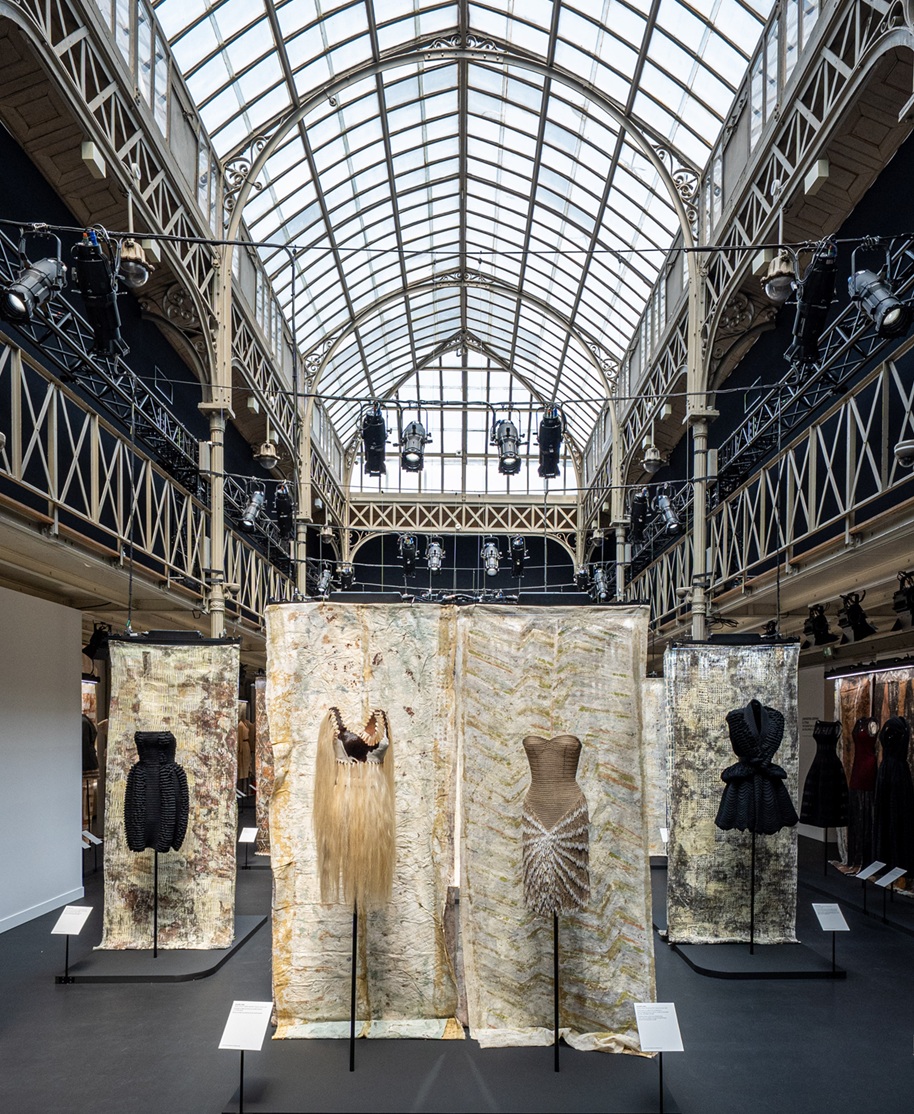
The new gallery is also distinguished by its architectural and scenographic choices. Careful work on light and the generosity of the volumes allow each work to exist fully, while open perspectives encourage connections between pieces.


The result offers a refined setting for the world’s civilizations, where dialogue between cultures unfolds without erasing the uniqueness of each.
A High-Level Museum Collaboration
For this project, the Louvre benefited from the collaboration of the musée du quai Branly–Jacques Chirac, a leading partner for non-European arts. Its expertise is reflected in the selection of works, their installation, and their richly documented presentation. For certain pieces, communities of origin were consulted to ensure a faithful and respectful display. Issues of collection, circulation, and restitution are addressed with clarity, shedding light on the often complex histories of the objects on view.
For those wishing to extend their exploration, the musée du quai Branly–Jacques Chirac remains the scientific reference, with its vast collections, research programs, and educational resources. Where the Gallery of the Five Continents offers an immersive and spectacular introduction for a broad audience, the Quai Branly provides a more academic and specialized deepening—two complementary approaches that reach all publics.
Beyond the Louvre, this opening confirms Paris as a crossroads of world cultures. Museums, specialized galleries, fairs, foundations, and dedicated urban routes position the French capital as a reference hub for these arts. Paris thus becomes a privileged place to explore, understand, and appreciate the diversity of cultures around the world.