In Gabriel Dia’s work, the body is rarely straightforward. It blurs, eludes the gaze and transforms, sometimes becoming almost unrecognizable. The photographer plays with what can be seen and what remains beyond the viewer’s reach, as though the image itself had to negotiate the conditions of its own appearance. This tension runs through his self-portraits, as well as his work with movement, clothing and materials. It takes on a particular resonance in Mother’s Heritage, an installation bringing together fabric, photography and memory.
Learning to Reveal Himself
Gabriel Dia arrived in France at the age of eighteen, having been forced to leave his native Senegal, where he could not live openly as a gay man. He went on to study engineering, while feeling the need to give artistic form to what he carried within him. Writing was his first means of expression: he published La Naissance d’une Vierge in 2013. A few years later, a friend gave him a camera. He discovered in photography a language capable of bringing together different dimensions of his experience, where words alone were not always enough. Photography thus became a way to explore his identity at his own pace, without having to tell his story head-on.
Self-portraiture occupies an important place in this approach. “I metamorphose. I become someone else in order to be myself,” he explains. Transformation does not necessarily mean turning away from oneself; it can also be a way of drawing closer to oneself from a different angle. The image becomes a space in which to experiment, push boundaries and embrace the freedom to inhabit several figures at once.
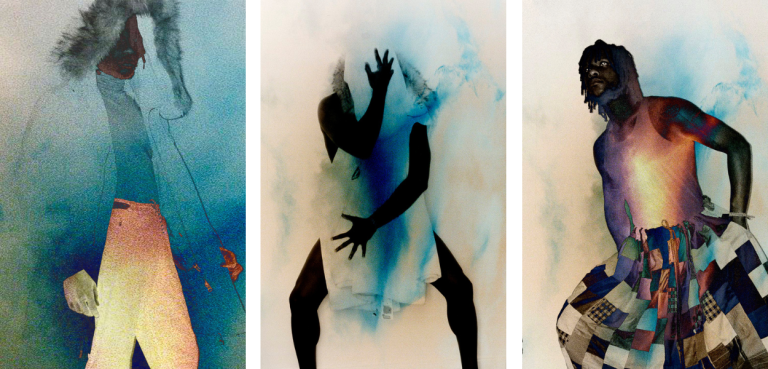
In Burning, created in 2020, Gabriel Dia faces the camera in a direct, almost defiant pose. His face seems to merge with his silhouette, while his body, rendered in heightened form, acquires a presence that is both sensual and unreal. The figure is there, exposed to the viewer’s gaze, yet remains difficult to recognize: the intensity of the image does not make his identity any more immediately legible. It transforms it. The body becomes a site of tension between presence and disappearance, between what is exposed and what eludes us.
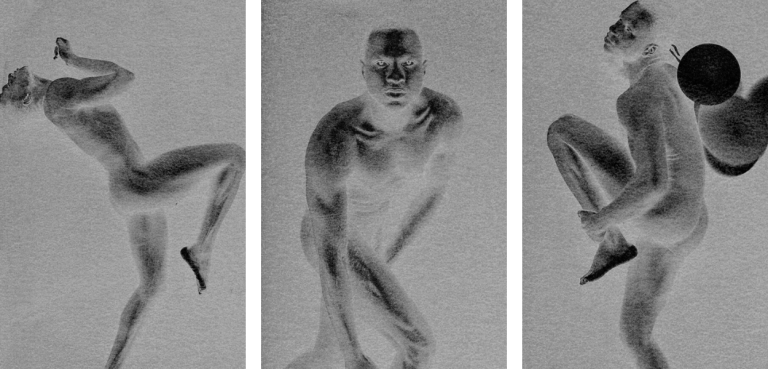
That same year, this exploration of visibility continued through movement in Sabar, whose title refers to a Senegalese dance traditionally reserved for women. Gabriel Dia recalls his mother’s furious reaction when, as a child, she found him dancing among a group of women. Years later, he returns to that gesture in front of his camera. What had once been interrupted can now be performed again, on his own terms. The body asserts itself through movement, while remaining partly concealed. In some images, a photographic negative placed in front of the lens disrupts the contours of the figure. The grain reinforces the impression of a presence that is at once visible and elusive. He reveals himself while maintaining a distance from the gaze. The veil no longer serves merely to obscure his identity: it accompanies a gesture he chooses to reclaim and stage on his own terms.
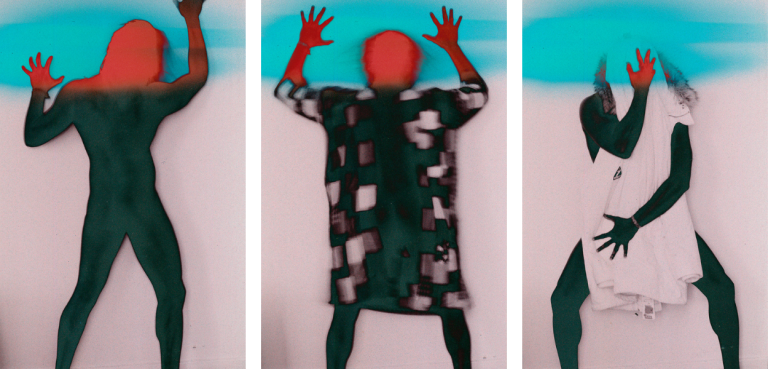
This search for self finds a further expression in clothing, which acts as a second skin: a protective layer that transforms appearance while also allowing personality to emerge. Developed during lockdown, the series Me Myself and I and Metamorphose each explore the role clothing plays in shaping appearance. Deprived of the opportunities to dress as he had before, Gabriel Dia became aware of how important clothing is to the way we present ourselves to the world. Clothing is no longer simply what covers the body; it helps determine how the body presents itself. In Metamorphose, it becomes a second skin, combined with image-making processes that further transform appearance. It allows him to choose a silhouette and assert a presence without relinquishing the part of himself he wishes to keep protected. Revealing oneself does not mean having to disclose everything; it can also mean retaining control over what one chooses to show.
The Photographer Who Would Have Liked to Be a Painter
For Gabriel Dia, pressing the shutter is only the beginning of a long creative process. A photograph may be revisited, rephotographed, projected, layered with other images or reworked with a paintbrush. Some evolve over months, sometimes years, before reaching their final form. The image is not treated as a result that must remain untouched, but as a material that can still be worked upon.
Dia, who would have liked to be a painter, finds in photography the opportunity to work on a surface, revisit a composition, shift forms and alter colours. He does not simply capture a moment: he continues working after the photograph has been taken, as though seeking to discover what else the image might become.
Monochromes sit alongside watercolours; double exposures blur silhouettes, while shadows and grain lend the bodies an almost ghostly presence. The images seem to fade away at times, only to reassemble themselves. These effects are not merely aesthetic experiments: they reflect a practice in which photography and painting continually inform one another. The photographed body provides the initial material, but composition, interventions and repeated reworking profoundly alter its appearance.
In keeping with this approach, Dia gives considerable importance to the unexpected. A superimposition produces an unforeseen effect, a colour transforms the atmosphere, a shape emerges where he did not expect it. “I love accidents,” he tells Fisheye Magazine. This appreciation of accidents does not mean that the work is left to chance. On the contrary, it requires attentiveness to what emerges, followed by a decision about how to develop it. Photography becomes an open-ended process in which intuition and patient work respond to one another.
This approach gives his images their distinctive character. They are neither simple portraits nor documentary photographs, but visual constructions developed through successive shoots and interventions. Dia’s work lies at the intersection of several gestures—photographing, painting, layering and reworking—which allow him to explore the possibilities of the image without defining its limits too soon.
Mother’s Heritage: Clothing as a Vessel of Memory
This exploration takes on a particularly personal dimension in Mother’s Heritage, which Gabriel Dia presents at AKAA as a large-scale installation. The project takes the photographer back to his mother’s sewing workshop. As a child, he would secretly try on the women’s clothes she made. One day, she caught him and became angry. The memory remained associated with an experience of incomprehension. Years later, Gabriel Dia returned to the workshop with his camera, this time in his mother’s presence. By turning this story into the material for an artwork, he creates the possibility of seeing it differently. His mother, too, can discover another dimension of the experience.
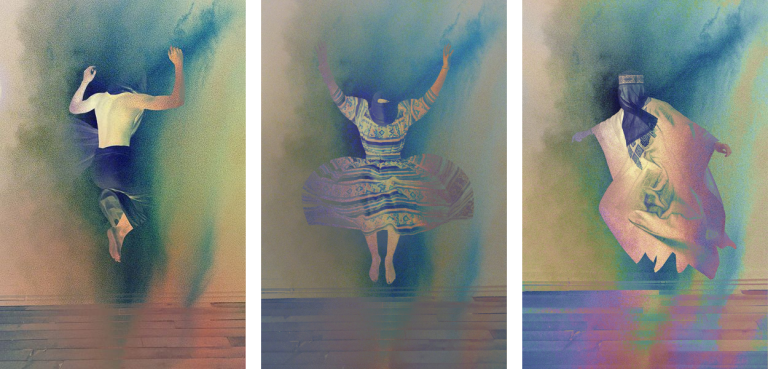
Mother’s Heritage – Constellation No. 1 features silhouettes of young men dressed in women’s clothing, in a composition that blends fiction with an intimate rewriting of the artist’s personal history. Clothing is central to the work: as form, as a covering for the body and as a vessel of memory. The fabrics and their patterns evoke family history while also pointing to the richness of textile skills passed down through generations.
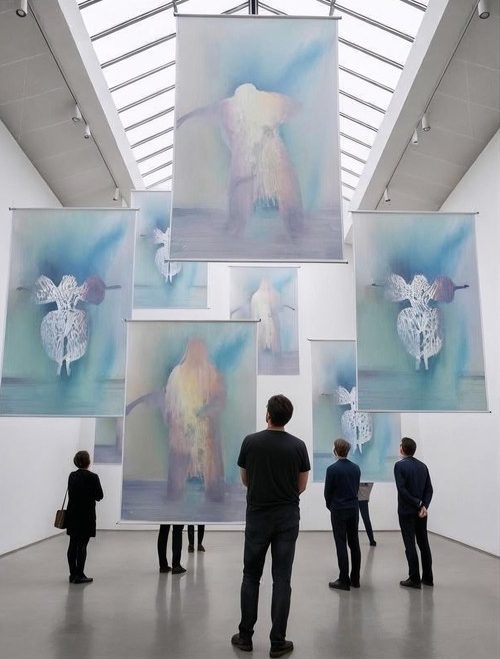
Created in 2025, the series takes on a new scenographic form at AKAA through an immersive installation. The photographs are printed in large format on lengths of fabric suspended throughout the space. The arrangement evokes laundry hanging on lines. The images float between presence and recollection, like fragments of a story that visitors discover as they move among the textiles. Fabric is no longer merely an element depicted in the photographs: it becomes the very support of the work, shaping the experience of memory.
The installation brings together several dimensions of Gabriel Dia’s practice. We encounter the staged body, clothing as a second skin, the image treated as material and memory transformed through creation. But the perspective shifts: the story is no longer solely about how an individual represents himself. It also concerns the relationship between a mother and her son, the transmission of craft skills and the possibility of looking at a painful past differently.
With Mother’s Heritage, Gabriel Dia neither reveals his entire story nor seeks to bring it to a definitive close. Instead, he gives it a form that can be shared while preserving its intimacy. The garments become witnesses to a memory that no longer belongs only to the person who lived it. They open up a space where personal history, cultural heritage and the gaze of others meet.