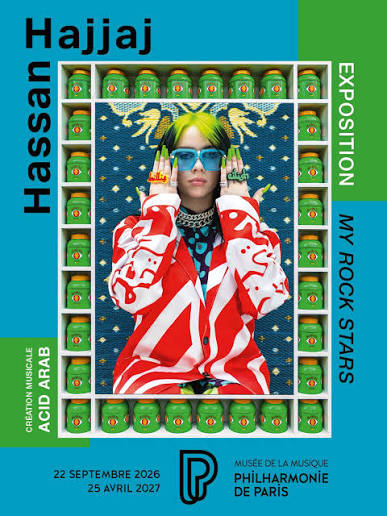
For Hassan Hajjaj, a “Rock Star” does not necessarily mean a celebrity, or even a music star, but rather someone he admires, someone who has played a part in his journey and whose individuality he seeks to bring to the fore. The project has taken shape through a succession of encounters, from the Gnawa musicians he began photographing in the 1990s to figures from international pop culture.
At the Philharmonie de Paris, a selection of around 35 photographs and personal archives presents this gallery of portraits, while a sound creation by Acid Arab extends the experience. The exhibition is part of a long-standing, international project, but its presentation at the Musée de la musique reveals one of its essential dimensions: for Hajjaj, music has long served as a thread connecting people, cultures and images.
Hassan Hajjaj: A Distinctive Visual Signature
Born in Larache in 1961, Hassan Hajjaj moved to London with his family as a teenager. Self-taught, he worked a succession of odd jobs before turning to organising parties and then to fashion. He opened a streetwear boutique, RAP, which quickly became a meeting place for designers, filmmakers and musicians. He also began working as a stylist and assisted designers with the production of fashion shows and music videos. In 1989, he bought a camera and began taking photographs, initially for himself, before gradually turning photography into an artistic practice. Photography became a privileged means of expression through which he could bring together the different worlds he encountered; portraiture gradually became the heart of his practice.
This approach to portraiture is rooted in his childhood experience of Moroccan photographic studios, where he would be photographed with his family, dressed in his finest clothes. He would later discover the work of Seydou Keïta and Malick Sidibé, whose studio portraits likewise give a central role to clothing, pose and setting. For Hajjaj, photographing someone means constructing their image. He chooses the clothes, accessories and setting; the frame itself is conceived as part of the artwork. Fashion and design therefore play a direct role in the making of the photograph. A piece of fabric, a crate, a bottle or an everyday object can become part of the composition; he may also design or commission specific pieces for his subjects.
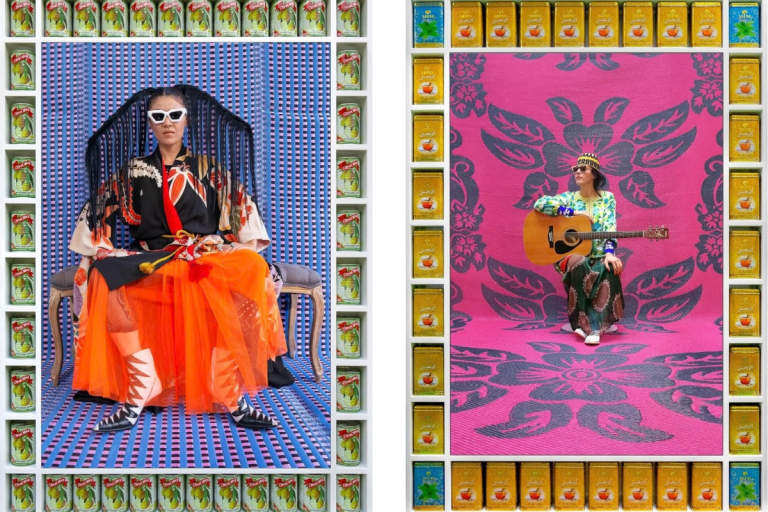
From this practice emerges an instantly recognisable visual language. Hassan Hajjaj brings together the legacy of African studio portraiture and Moroccan references with London’s pop culture and urban scenes, and fashion with a culture of appropriation rooted as much in the street as in consumer culture. His images play with saturated colours, geometric patterns and exuberant compositions in which clothes, accessories and objects sometimes seem to spill beyond the frame. Yet this visual abundance is never purely decorative: it contributes to the construction of the character and gives each image an almost theatrical energy. The frames themselves become artworks in their own right, extending the portrait graphically and emphasising its constructed nature.
This distinctive aesthetic has earned him international recognition, as well as the nickname “Andy Wahloo”, coined by his friend Rachid Taha in reference to Andy Warhol. The comparison notably reflects their shared taste for vivid colours, bold constructions, popular figures and the signs of consumer culture. In Hajjaj’s work, these elements are transformed into a personal visual language that extends across his journey from styling to music, as exemplified by his My Rock Stars series.
My Rock Stars: Building a Pantheon
With My Rock Stars, this approach to portraiture focuses on personalities connected to the world of music. The project began taking shape in the 1990s, when Hassan Hajjaj photographed Gnawa musicians, before expanding to artists he encountered throughout his career. Rachid Taha, Lee Scratch Perry, Madonna, Alicia Keys, Swizz Beatz and Billie Eilish appear alongside figures less familiar to the general public. What brings them together is neither their fame nor their musical style, but Hajjaj’s personal connection to them: each belongs to his own pantheon.
The diversity of these personalities is an integral part of the project. Their generations, nationalities and musical genres may differ, but all are approached through the same portrait-making process. Hassan Hajjaj selects the clothes, accessories and setting down to the smallest detail. Preparing the Rock Stars is a true protocol: every element of the staging contributes to the construction of the character. Gnawa masters, reggae artists, hip-hop figures and pop stars thus become protagonists of the same visual family.
The photographic session itself is a creative moment. Some shoots may even be accompanied by live performances; the artists play, improvise or simply take possession of the setting. The portrait retains something of this encounter. It does not merely seek to show a face, but to reveal a presence, an energy and a world.
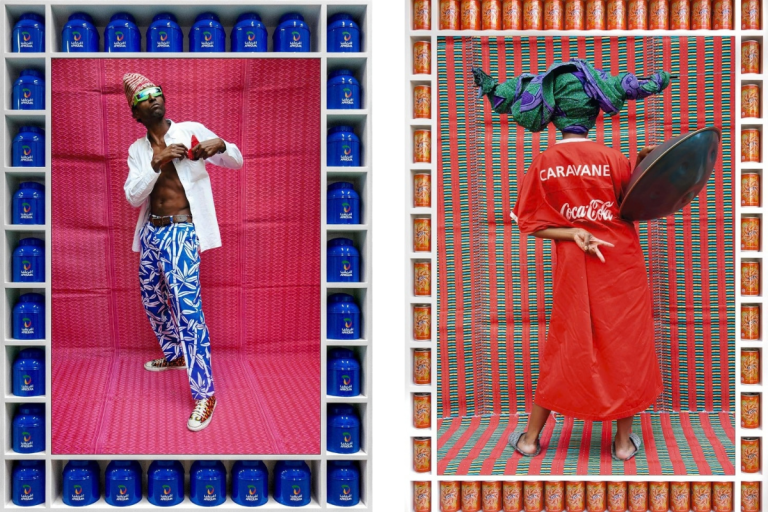
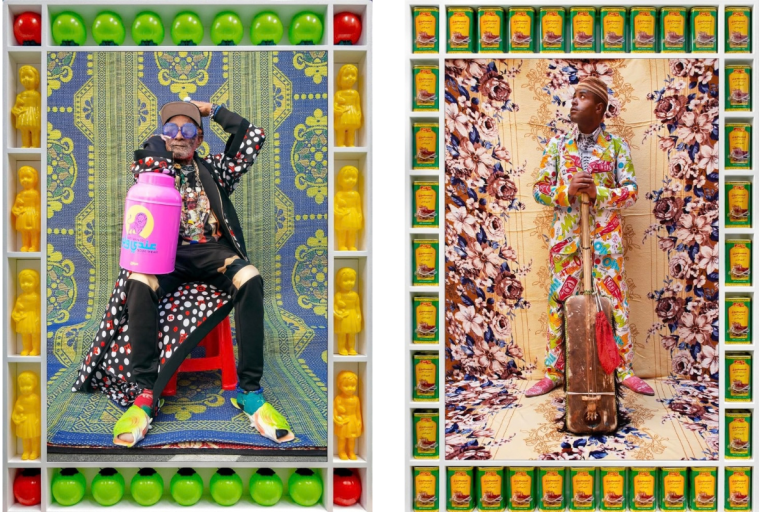
![Mariam & Amadou, 2017/1438 ; Alicia & Swizz [Alicia Keys et Swizz Beatz], 2023/1444 © Hassan Hajjaj](https://www.africasvibes.com/wp-content/uploads/2026/09/Design-sans-titre-2026-09-25T094628.599-768x512.png)
![Mehdi Nassouli, 2018/1439 ; Khadija Lgnawia [Khadija Ouarzazi], 2012/1433 © Hassan Hajjaj](https://www.africasvibes.com/wp-content/uploads/2026/09/Design-sans-titre-2026-09-25T092556.510-768x512.png)
The project sometimes extends beyond photography alone, as with My Rock Stars Experimental, Volume 1, presented first at LACMA and then at the Wexner Center for the Arts. Filmed performances by the musicians photographed by Hassan Hajjaj extend their portraits, transforming the photographic session into a fully staged experience.
It is this spirit of cross-disciplinary practice that can be found today at the Philharmonie: a project in which the portrait is never isolated, but enters into dialogue with music, objects, clothing and the space surrounding it.
The Philharmonie: When Image Resonates with Music
After travelling around the world, My Rock Stars now takes on a new presentation at the Philharmonie de Paris, where the project enters into an unprecedented dialogue with the collections of the Musée de la musique.
The exhibition is part of a rethinking of the museum’s presentation in 2025, designed to foster greater dialogue between the musical heritage represented in its collections, drawn from around the world. My Rock Stars naturally resonates with this new configuration: Hassan Hajjaj has himself built his work through encounters between different musical scenes and cultures. The music he encountered in London, Gnawa traditions and, later, artists from international scenes come together in a story of movement and exchange in which music acts as a connecting thread.
The exhibition is accompanied by an original sound creation by Acid Arab, whose work for more than a decade has explored encounters between electronic music and the musical traditions of North Africa and the Middle East. For My Rock Stars, the group does not simply provide a musical accompaniment to the photographs: its creation extends the principle of cultural cross-pollination that runs through Hajjaj’s work. Traditional sounds from the Arab world mingle with electronic bass lines and pulses drawn from contemporary musical cultures. The result takes visitors through different sonic textures, much as Hassan Hajjaj moves his subjects between different visual worlds.
This sound creation also changes the way the portraits are perceived. The images show artists who have played a part in Hajjaj’s life; the sound reminds us that their presence cannot be reduced to their faces or status. It conveys something of the musical energy that connects them and has fuelled the project since its beginnings. The exhibition does not simply juxtapose photography and music: it seeks to make them work together.
This is where the Philharmonie’s approach finds its particular character. By bringing Hajjaj’s portraits into dialogue with its collections and pairing them with an original sound creation, it transforms My Rock Stars into an experience in which photography and music are no longer simply juxtaposed, but placed in dialogue.