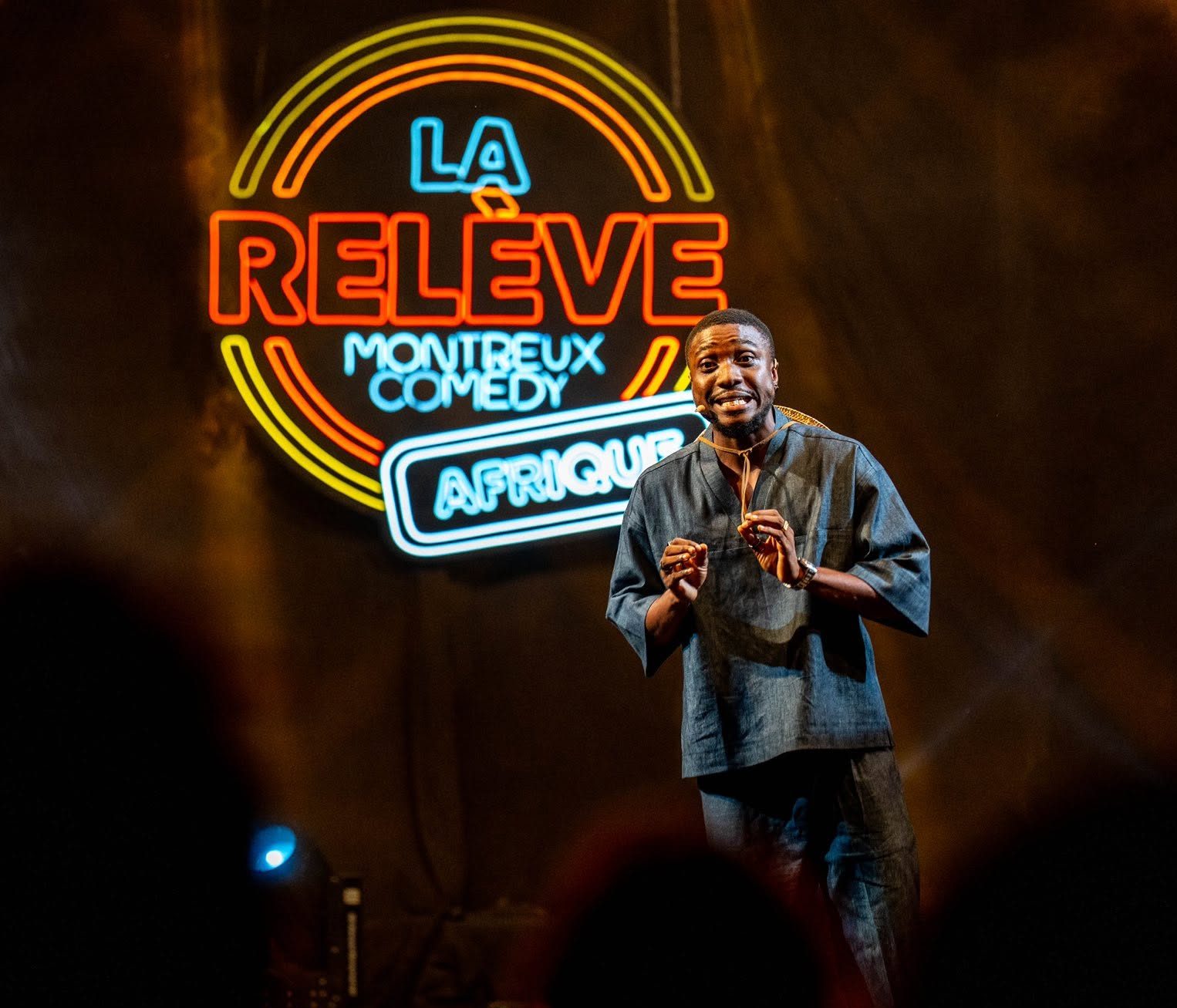
On 12 June 2026, in Cotonou, Ivorian comedian Ange Borys won the All Stars edition of La Relève Afrique, defeating Beninese comedian Sam du Barça. The final brought a remarkable season to a close, bringing together emblematic former contestants and emerging talents.
Beyond the results, this anniversary edition provided an opportunity to measure the progress made by a generation of comedians revealed through the competition and to observe the gradual transformation of a Francophone African comedy scene that is increasingly structured.
All Stars 2026: A Coming-Of-Age Edition
Over the years, La Relève Afrique has established itself as one of the leading formats shaping the continent’s comedy scene. The competition is organised in several stages: national selections, writing and performance phases, followed by live performances in front of audiences and a jury made up of professionals from the cultural and audiovisual sectors.
The 2026 edition stood apart from previous seasons. The “All Stars” format brought together fourteen of the most remarkable talents from past editions, joined by two “rookies” selected through an online casting process held across ten Francophone countries, combining experience and fresh perspectives. Sixteen comedians representing nine African countries gathered in Cotonou for twelve days of stage challenges, combining written sketches and improvisation, leading up to the final.
The final offered a snapshot of a Francophone African comedy scene in the making, where writing styles are diversifying and artistic identities are becoming increasingly distinctive. Ange Borys (Côte d’Ivoire) demonstrated a highly personal writing style rooted in everyday observations. Sam du Barça (Benin) captivated audiences with a style built around irony and absurdity, transforming ordinary situations into satirical reflections on social contradictions. Bony le Guerzé (Guinea), who often combines comedy and music; Momo l’Intellectuel (Burkina Faso), whose stage persona draws on a more thoughtful and reflective approach; and Tchoukouni (Côte d’Ivoire), who draws inspiration from everyday situations and social observation, completed the line-up of finalists. Together, their different approaches reflect the diversity of a new generation of African comedians.
At the end of the final, Ange Borys claimed victory over Sam du Barça. Following previous winners Bappa Oumarv (Guinea), Venance Jappe (Benin), Kady (Benin), Black Panda (Congo-Brazzaville) and Le Gourou (Congo-Brazzaville), he delivered Côte d’Ivoire its first victory in the competition.
By choosing to share his prize — a cheque for 5 million CFA francs — with the other finalists, the winner offered a powerful symbol of the spirit of community and solidarity that developed throughout the competition, beyond the simple pursuit of victory.
More Than a Competition: An Incubator for a New Generation
If La Relève Afrique has become an established name in Francophone stand-up, it is because it goes beyond the framework of a traditional competition to operate as a structured artistic development platform.
Created by Grégoire Furrer Productions and the Castel Group, the programme aims not only to discover new talents, but also to contribute to the long-term professional development of African comedians by providing access to training tools, visibility platforms and international professional networks.
Participants do not join the programme simply to perform. They follow a structured pathway combining training sessions, masterclasses and workshops focused on content creation, stage performance and career management. The objective is to help them refine their practices, strengthen their artistic identities and provide them with the tools needed to build sustainable careers.
The programme also offers participants significant professional exposure. They are assessed by a jury of cultural and audiovisual experts, including, for this edition, Grégoire Furrer, founder of the Montreux Comedy Festival, and Lionel Talon, a specialist in cultural and creative industries in Benin.
Performances are also recorded and widely distributed, generating media visibility beyond local stages. With more than 40 million cumulative views and 15 programmes co-produced and broadcast with Canal+, La Relève Afrique enables talents to reach a wider Francophone audience.
This exposure represents a first step towards other stages and professional networks. The winner receives an invitation to perform at the Montreux Comedy Festival, considered one of the leading stages for Francophone stand-up worldwide, as well as access to Jokenation, an artistic network facilitating connections between Francophone comedy scenes.
Within this ecosystem, La Relève Afrique appears as the first link in a broader chain of talent identification, training and circulation.
A Comedy Ecosystem Taking Shape
Contemporary African comedy is rooted in a much older history, where griots, storytellers and forms of popular satire already used humour as a tool for transmission and social commentary. Stand-up extends this heritage into a new framework, shaped by urban stages and individual storytelling.
Today, the continent is witnessing the emergence of a genuine ecosystem. Abidjan Capitale du Rire paved the way, the Canal Comedy Club is expanding across more than ten countries, while the Cotonou Comedy Festival, supported by Montreux, confirms the rise of continental comedy formats. Competitions such as the Awards du Rire Africain in Niamey, Stand-up Show in Benin and Comedy Show RTI in Côte d’Ivoire provide additional stepping stones for developing comedians.
This momentum now extends beyond African borders. Social media allows a sketch created in Abidjan, Dakar, Cotonou, Paris, Brussels or Montreal to circulate instantly across continents. International festivals, starting with Montreux, are increasingly opening their stages to African talents, while professional networks are helping structure increasingly transnational careers.
La Relève Afrique could also find an extension through La Relève Monde, a new international competition project aiming to bring together, in the future, winners from the different versions of the programme organised notably in Switzerland, Belgium, Canada and Haiti. Beyond a simple competition, the ambition is to create a Francophone artistic ecosystem where African comedians can engage with other scenes and audiences.
In this context, La Relève Afrique is no longer limited to discovering talents. It contributes to highlighting the emergence of an ecosystem capable of developing its own structures, circulation networks and professional pathways across the Francophone world.oader chain of talent identification, training and circulation.day, the programme stands not simply as a competition, but as one of the clearest indicators of the remarkable transformation taking place across Francophone African stand-up.