Since its creation in Luanda in 1997, the Biennale of Dance in Africa has accompanied the rise of contemporary African dance. Initially conceived as a simple choreographic competition, it gradually evolved into a platform bringing together artists, choreographers, and cultural professionals from across the continent and the diaspora.
Built on a principle of itinerancy, it changes host countries every two years. This movement across the continent allows works, artists, and perspectives to circulate, while connecting scenes that are often isolated from one another. From Luanda to Maputo, via Antananarivo, Tunis, Bamako, Johannesburg, or Ouagadougou, each edition has helped shape a geography of contemporary African creation.
In 2026, for the first time, the Biennale was held in Senegal, between Toubab Dialaw and Dakar. This shift gave its thirtieth anniversary a particular resonance: an event returning to one of the major birthplaces of contemporary African dance while simultaneously projecting itself toward a rapidly evolving scene.
Between Leading Figures and New Generations
The thirtieth anniversary of the Biennale featured several standout performances, including Le Combat des Lianes by Cameroonian choreographer Zora Snake, a major figure of politically engaged dance. The Béninese company Multicorps offered a more fragmented writing style, shaped by tensions within collective structures. Body Ability, from South Africa, explored the fragility of bodies within their own virtuosity, while Raiz di Polon, a Cape Verdean collective, presented work rooted in island narratives, departures, and returns. Alleyne Dance connected Caribbean heritage with European contemporary writing in a highly structured composition.
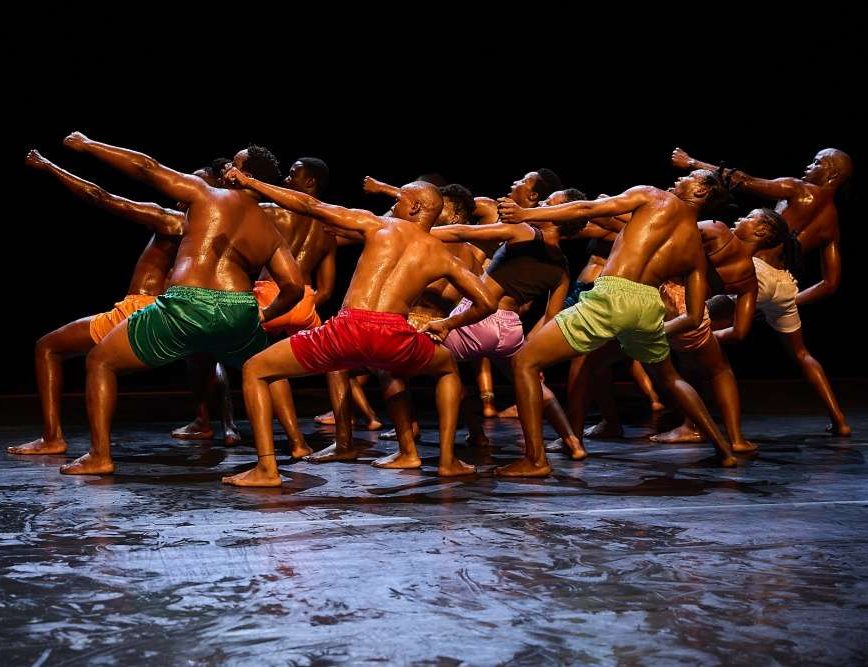
The week concluded with Vagabundus by Mozambican choreographer Idio Chichava, one of the most widely acclaimed works of African contemporary choreography in recent years. Bringing together thirteen dancers and singers, the piece unfolds a rare collective energy. Inspired by choreographic and musical traditions from northern Mozambique, it explores notions of displacement, community, and belonging through a continuous movement in which individual identities gradually dissolve into the group. A powerful way to close this anniversary edition: by recalling that dance is also a shared experience of the collective.
But the Biennale would not be the Biennale if it only brought together established artists. Its specificity lies precisely in its ability to give equal visibility to emerging creators. Out of more than 300 applications from Africa and the diaspora, twenty-five companies were selected. Ten were Senegalese, a particularly strong presence reflecting the vitality of the local scene.
Cheikh Ibrahim Thiam, known as Chico, Fatou Samb, Ibrahima Niassy, known as Pisco, and Jules Romain Djihounouck presented works addressing themes as diverse as the environment, memory, identities, and urban cultures. Through Droits de la Nature, Lénen Fénen, Tafaar, Mouton Noir, or Xaritò, a generation emerges that no longer seeks to have contemporary African dance recognized: it fully inhabits it, enriches it with new narratives, and opens it to new horizons.
From the Cradle of Contemporary Dance to an Emerging Cultural Capital
If Senegal was chosen as host country for this anniversary edition, it was not only for the quality of its current artistic scene. The very geography of the event carried meaning. The Biennale unfolded across two sites that tell two complementary stories.
For five days, the Biennale took place at the École des Sables, in Toubab Dialaw. Founded by Germaine Acogny in the late 1990s, this institution has become one of the most influential centres of contemporary African dance. Generations of dancers and choreographers from across the continent have been trained, hosted in residency, or supported there. More than a school, the École des Sables has become a laboratory where reflections on the body, transmission, and African choreographic heritage have been developed for nearly thirty years. Celebrating the Biennale’s anniversary there amounted to acknowledging the foundational role played by Germaine Acogny in this history.
But the event did not stop in Toubab Dialaw. From May 4th onwards, the Biennale moved to Dakar, notably at the Théâtre national Daniel Sorano and the Institut français. This second moment revealed another reality: that of a capital progressively asserting itself as one of the continent’s major creative hubs. Driven by DAK’ART, its galleries, cultural centres, and a particularly dynamic artistic scene, Dakar has for several years been developing the ambition to become a major platform for African contemporary art. The presence of numerous Senegalese companies in the programme confirms that dance is fully part of this dynamic. This vitality relies on a dense network of schools, companies, festivals, and creative spaces that have gained significant visibility over the past decade.
Between Toubab Dialaw and Dakar, the Biennale thus drew a highly symbolic geography: on one side, a place that tells the history of contemporary African dance; on the other, a city contributing to shaping its future.
More Than a Festival, an Ecosystem
At both Toubab Dialaw and Dakar, beyond performances, the Biennale multiplied spaces for transmission and reflection. Masterclasses led by Khady Badji or Alleyne Dance, workshops for young audiences at the Yene high school and Djaramart school, round tables on artist mobility, funding, and cultural policy, film screenings, as well as photographic and visual art exhibitions: all these events extended the work presented on stage.
Since its creation, the Biennale has not been limited to presenting works. It has actively contributed to structuring an ecosystem still under construction. Over successive editions, it has helped connect isolated scenes, facilitate circulation of artists across countries, and link programmers, cultural institutions, festivals, and training centres. In a context where infrastructure remains uneven across the continent, this role of networking has often been as decisive as the programming itself.
This platform has provided artists with decisive visibility. Early in his career, the Biennale offered exposure to Congolese dancer and choreographer Faustin Linyekula, who has since become one of the most influential African creators of his generation. Nigerian choreographer Qudus Onikeku was still relatively unknown when he received the Biennale’s Grand Prize; fifteen years later, he is one of the major figures of contemporary African choreography. The same applies to Burkinabè artists Salia Sanou and Seydou Boro, whose careers have helped establish Ouagadougou as one of the historic capitals of contemporary dance on the continent.
Thirty years after its creation, this function remains intact. The major figures present in Senegal this year recalled how far the field has come. The selected emerging companies suggested the paths still to be explored.
Among them may already be the choreographers who will, in twenty years, tell the next chapter of contemporary African dance. This is perhaps the Biennale’s most enduring achievement: not to celebrate established stars, but to continue, edition after edition, to make visible those who are only just beginning to emerge.