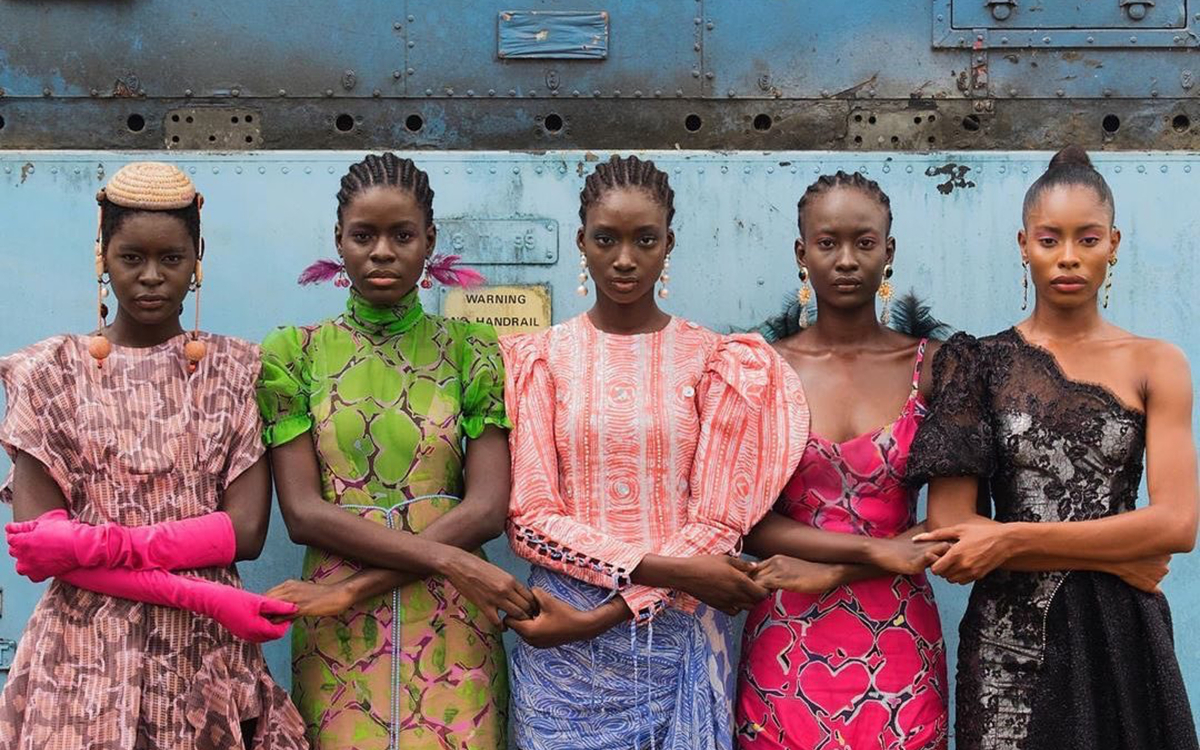
From the moment visitors enter the Galerie Jardin of the Musée du quai Branly – Jacques Chirac, the eye is drawn to the brilliance of colors and the richness of textures. Malian bogolan meets Ghanaian kente; ndop textiles weave connections between tradition and contemporary creation.
Conceived by the Victoria and Albert Museum, this travelling exhibition takes on a new dimension in Paris. Revisited to engage in dialogue with the museum’s permanent collections, it offers a renewed perspective on African fashion—immersive and resolutely contemporary.
A Project Born to Rewrite Fashion History
At the Victoria and Albert Museum, a leading institution for decorative arts in London, contemporary African fashion long remained on the margins, overshadowed by so-called traditional textiles and ethnographic objects. A striking absence, given that since independence, the continent has continuously generated forms, styles and designers in dialogue with the world.
From this observation, Africa Fashion was born. The museum undertook an unprecedented research and collecting effort: meeting designers, documenting their journeys, acquiring key pieces. A living archive gradually took shape, culminating in a first exhibition in London in 2022, led in particular by curator Christine Checinska.
Its ambition: to shift perspectives. African fashion is no longer seen as peripheral or merely a source of inspiration, but as a creative center in its own right. The narrative is anchored in the pivotal moment of independence, when clothing became a manifesto, asserting identities and cultural sovereignty.
From the outset, the ambition extends beyond the museum. Africa Fashion offers a re-reading of fashion history, reinserting African designers into a global narrative from which they were long absent.
Fashion and Identity: A Continent in Motion
Entering Africa Fashion feels like stepping into a vibrant atelier: colors burst, textures come alive, volumes inhabit the space. More than six decades of African fashion unfold, from the independence era to the bold expressions of the 21st century. The scenography highlights a form of “Afro-Modernity”—where craftsmanship, heritage and innovation converge.
The journey begins with the pioneers: Shade Thomas-Fahm, the first Nigerian woman to open a fashion house in the 1960s; Chris Seydou, who transformed bogolan into structured garments; and Kofi Ansah, who fused kente with British tailoring.
Alongside them, a new generation extends and reinvents this legacy: Thebe Magugu embroiders Setswana proverbs into his designs; Imane Ayissi elevates ndop textiles into couture coats; IAMISIGO sculpts silhouettes inspired by Yoruba hairstyles.
Each piece embodies the dialogue between tradition and modernity. Iconic textiles—bogolan, kente, adire—become vehicles of identity and expression, while inspiring some of the most innovative silhouettes in contemporary fashion.
Accessories, photographs, videos and archives complete the experience, offering insight into the social and historical context of each creation. Through this diversity, Africa Fashion demonstrates that African fashion is not merely aesthetic: it tells stories, transmits culture, and asserts itself as a major creative force on the global stage.
An Exhibition in Constant Transformation
Since its inception, Africa Fashion has travelled and evolved at every stage. In London, the narrative is foundational and historical. In Melbourne, it becomes more spectacular, playing with scale and color to evoke the energy of African workshops and markets. In Chicago, it turns more immersive, inviting visitors to move closer and engage with materials. Montreal offers a more pedagogical approach, attentive to political, social and cultural contexts.
In Paris, a new dialogue emerges. The Musée du quai Branly – Jacques Chirac incorporates a rarely displayed selection from its own collections: historical textiles, ritual jewelry, 19th-century fabrics and archival photographs. This encounter between past and present reveals the continuity and depth of African creativity, where heritage transforms into innovation.
The Paris scenography, structured in seven sections (Post-Independence Renaissance, Afrotopia, Haute Couture, Minimalism, Combinations, Collaborations and Craftsmanship), favors a sensory experience. Freed from rigid display cases, the works breathe on curved structures reminiscent of Ouagadougou markets; light reveals textures, patterns and details. Here, fashion regains its original movement.
The Galerie Jardin becomes a space both patrimonial and sensory, where contemporary creation engages with memory. And in Paris—a historic capital of couture—a shift becomes clear: Africa is no longer a periphery—it is one of the centers of global fashion.